“Tennis racket” and “badminton racket” are close in language space. “Climbing shoes” and “chalk bag” look less similar in text, yet the same users often consume them together.
That is the central tension in generative recommendation:
language semantics: what is it?
collaborative semantics: who wants it, and in what context?
TIGER derives IDs mainly from content. GPTRec derives SVD tokens mainly from behavior. LC-Rec: Adapting Large Language Models by Integrating Collaborative Semantics for Recommendation tries to preserve both inside a pretrained LLaMA.
Its central move is not merely concatenating two embeddings. It builds translation tasks around the triangle item ID ↔ item language ↔ user behavior.
The paper in 30 seconds
- The open problem: content Semantic IDs support semantics and cold start but do not equal collaborative behavior; collaborative tokens preserve behavior but cannot readily exploit LLM world knowledge.
- LC-Rec's answer: quantize LLaMA item embeddings into four-level indices; use Uniform Semantic Mapping to balance final-level assignments; align language and behavior through sequence, bidirectional translation, intent, and preference tasks.
- The result: on Arts, LC-Rec reaches 0.0906 NDCG@10 versus TIGER's 0.0703. The sequence-only model scores 0.0812 and rises stepwise to 0.0906 as mutual, asymmetric, intent, and preference tasks are added.
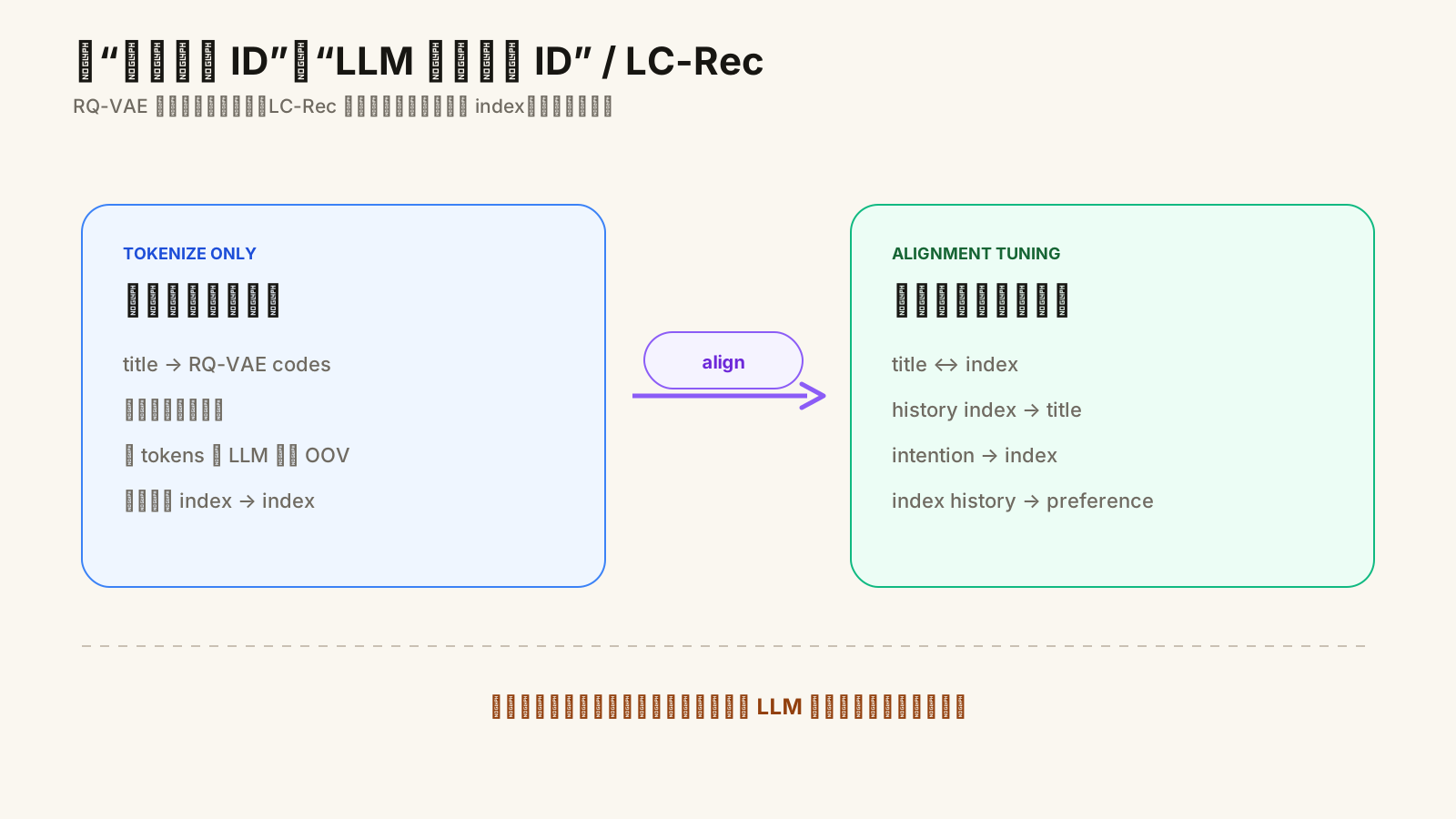
Figure 1. LC-Rec does not assume one vector naturally carries every meaning; it builds supervised translation paths among representations.
Why an ID needs two kinds of meaning
Consider our eight items:
| Pair | Language relation | Collaborative relation |
|---|---|---|
| Tennis–badminton rackets | Similar nouns and form | Users may specialize in different sports |
| Climbing shoes–chalk bag | Different categories | Frequently occur in one climbing task |
| Swim cap–sports towel | Different functions | Sequentially related around swimming |
A tokenizer optimized only for title reconstruction may group every racket. Recommendation instead needs the local structure of what follows in this user's current context.
LC-Rec treats the item index as an interface between an LLM and a catalog. An ideal index should:
- be inferable from text, so new items can be named;
- be predictable from history, so behavior is retained;
- generate text in reverse, so codes are not entirely opaque;
- be unique and valid for full-catalog retrieval.
Alignment tasks with eight items
Suppose I06 goggles has index <a17><b83><c41><d06>.
Sequential recommendation (SEQ)
<I01 index>, <I03 index>, <I05 index>, <I07 index>
→ <I06 index>
This ordinary next-item task contributes collaborative and sequential evidence.
Explicit mutual translation (MUT)
"anti-fog training goggles" → <I06 index>
<I06 index> → "anti-fog training goggles"
Both directions attach new index tokens to LLaMA's language space.
Implicit asymmetric prediction (ASY)
index history → next-item title
title history → next-item index
The model cannot remain inside a code-only or text-only closed format.
Intention and preference (ITE / PER)
The paper asks GPT-3.5 to derive user intentions and explicit preference text from reviews, then trains:
user intention → item index
index history → preference text
This makes behavior interpretable, but it also imports the synthetic teacher's biases.
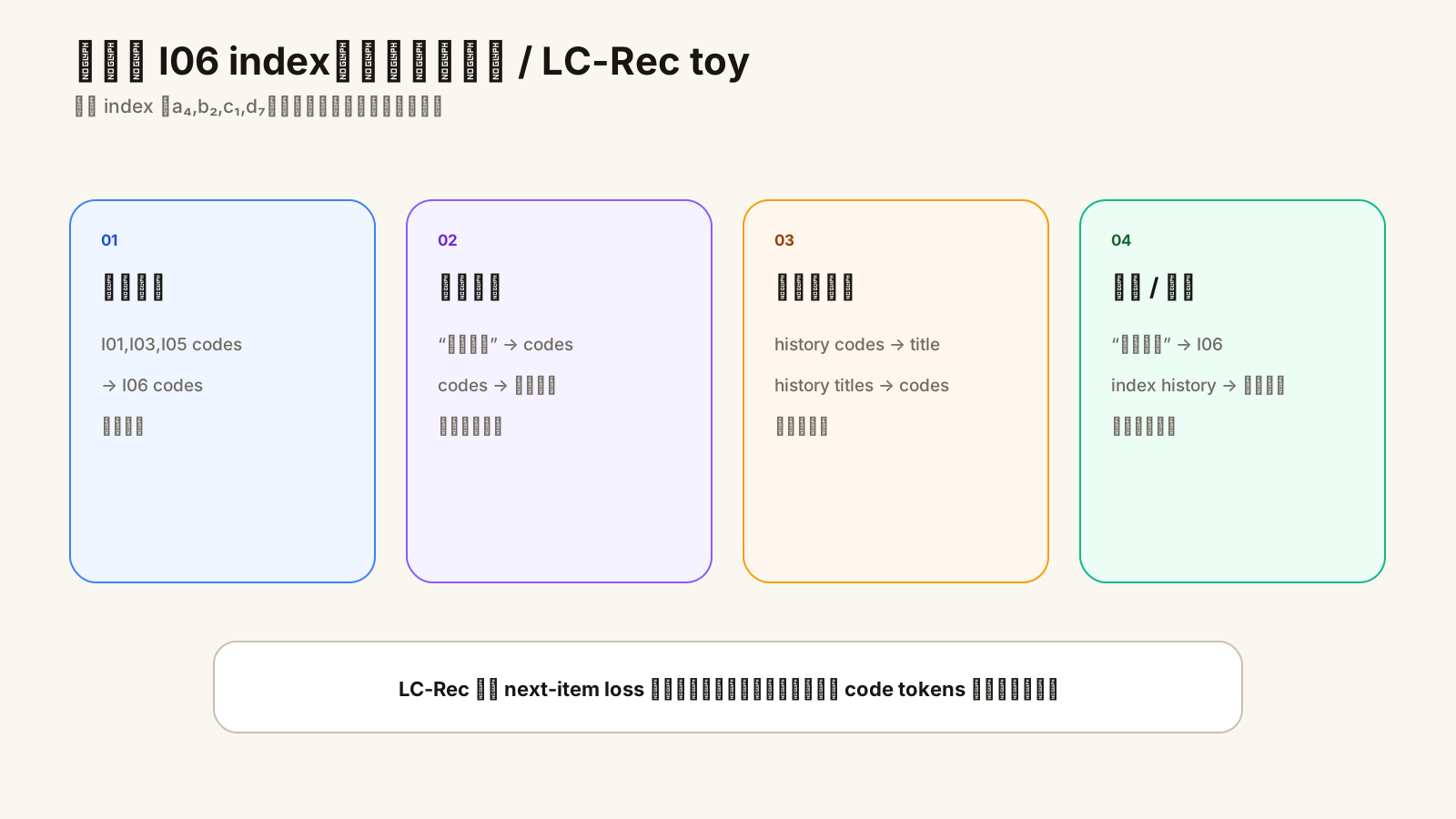
Figure 2. The item index is a hub spanning code-to-code, text-to-code, and code-to-text information flows.
Removing collisions with Uniform Semantic Mapping
LC-Rec mean-pools LLaMA representations of titles and descriptions, then applies an RQ-VAE with four levels, 256 codes per level, and 32-dimensional code embeddings. It adds roughly 1,000 tokens.
A normal RQ-VAE can assign the identical code sequence to multiple items. TIGER appends an arbitrary collision suffix. LC-Rec instead applies Uniform Semantic Mapping (USM) at the final level, distributing a batch of residuals approximately uniformly across codes:
[ \min_q \sum_r\sum_k q(k\mid r)\lVert r-v_k\rVert_2^2 ]
[ \text{s.t.}\quad \sum_k q(k\mid r)=1,\qquad \sum_r q(k\mid r)=\frac{|B|}{K}. ]
- (r) is an item residual entering the final quantizer;
- (v_k) is code (k);
- (q(k\mid r)) is a soft assignment;
- the first constraint assigns each residual once;
- the second gives every code equal batch mass.
The paper uses Sinkhorn–Knopp optimal transport. Distance preserves local similarity while capacity prevents a few popular codes from absorbing everything.
From input to output
All index codes are added to the LLaMA vocabulary. A recommendation prompt may look like:
Instruction:
Given the user's interaction sequence, recommend the next item.

History:
<a12><b07><c44><d03> ...
The decoder produces four index tokens. At inference, a catalog prefix trie masks any token that is not a valid child of the generated prefix. LC-Rec uses beam size 20 for full-catalog generation.
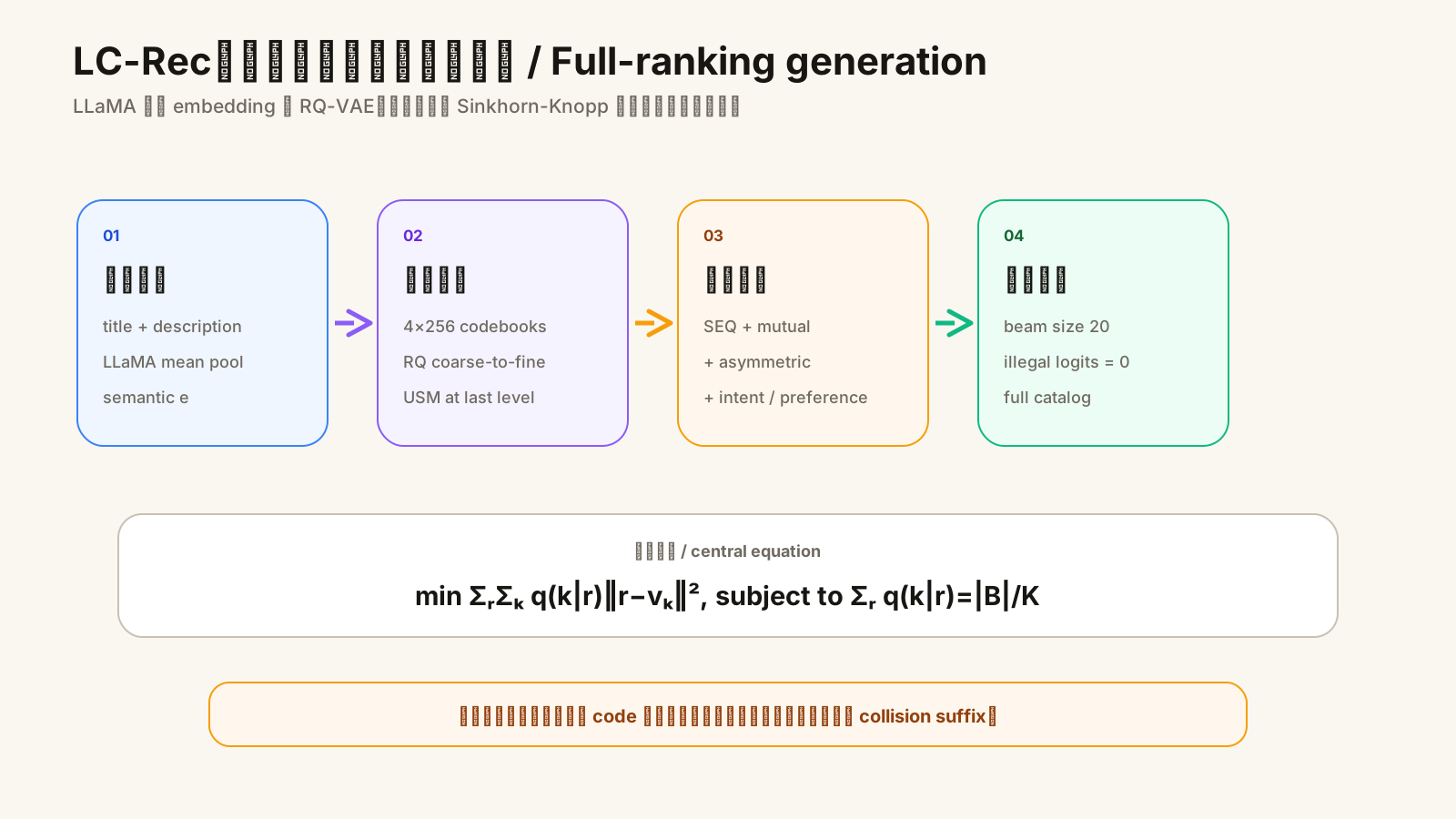
Figure 3. An offline item index enters LLaMA; multitask tuning links language, behavior, and catalog-constrained output.
All tasks use token negative log-likelihood:
[ \mathcal L =-\sum_{\tau\in\mathcal T}\sum_{(x,y)\in D_\tau} \sum_t\log P_\theta(y_t\mid y_{<t},x), ]
where (\mathcal T) contains SEQ, MUT, ASY, ITE, and PER. The model randomly selects an instruction template for each sample in each epoch and fine-tunes LLaMA for four epochs.
What the experiments establish
Full-ranking results on three Amazon subsets are:
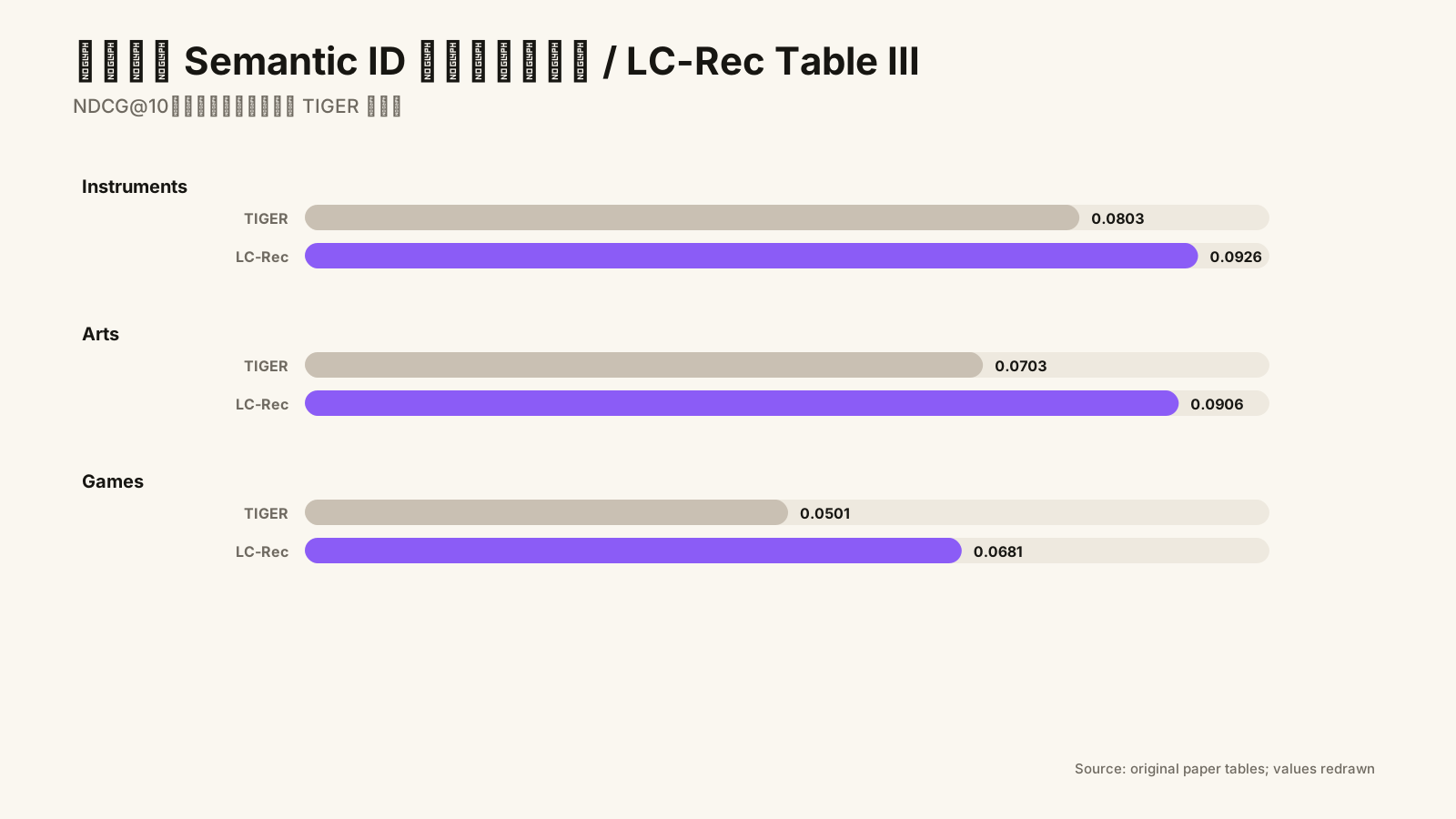
Figure 4. LC-Rec beats TIGER on all three subsets; the accumulation of distinct alignment tasks is more informative than the final score alone.
| Dataset | TIGER | LC-Rec |
|---|---|---|
| Instruments | 0.0803 | 0.0926 |
| Arts | 0.0703 | 0.0906 |
| Games | 0.0501 | 0.0681 |
On Arts, the task ablation reads:
| Tasks | NDCG@10 |
|---|---|
| SEQ | 0.0812 |
| + MUT | 0.0832 |
| + ASY | 0.0848 |
| + ITE | 0.0889 |
| + PER | 0.0906 |
Games similarly rises from 0.0535 to 0.0681. Intent and preference text contribute substantially: pretrained language ability turns into recommendation gains only when explicit objectives connect it to the item index.
The paper also constructs semantically similar negatives. LC-Rec scores 75.73% accuracy on language negatives versus SASRec's 73.52%, and 60.01% on collaborative negatives versus 52.25%. This supports partial preservation of both signals, while the 60% result also shows how incomplete collaborative discrimination remains.
Where LC-Rec breaks
The tokenizer remains offline
The item index is frozen before recommendation tuning. Recommendation gradients cannot repair code boundaries that are hard to predict or rank.
Auxiliary language is synthetic
GPT-3.5 generates intentions and preferences from reviews. The signal may be useful abstraction, but it may also carry templates, hallucinations, or leakage. Users without reviews lack equivalent supervision.
Serving is expensive
A 7B-class LLaMA with beam-20 autoregressive full-catalog decoding is much heavier than SASRec dot products or ANN. Experiments use catalogs of roughly ten thousand items.
General and recommendation abilities may conflict
Adding about 1,000 codes and multitask tuning can alter the base model's language ability. The paper notes the risk but does not systematically test catastrophic forgetting or instruction generalization.
IDs remain versioned state
Retraining RQ-VAE can change addresses. Model weights, converted histories, the valid trie, and caches require an atomic migration. USM balances one version; it does not guarantee identity across versions.
Why LETTER comes next
LC-Rec shows that multitask alignment can connect language and collaboration, but the tokenizer itself is still optimized mostly for content reconstruction. We can now ask directly:
What makes an item ID good specifically for recommendation?
It should offer:
- hierarchical semantic structure;
- collaborative proximity for items consumed by similar users;
- diverse code assignment rather than codebook collapse.
LETTER, in the next chapter, writes these three properties into the tokenizer objective and adds ranking-guided generation to move the learned ID closer to ranking quality.
Critical takeaway: LC-Rec advances interface alignment; it does not prove that language and collaborative semantics have become one perfect space. Its translation tasks let one item index travel across modalities, while a frozen tokenizer, synthetic supervision, and costly decoding keep the method far from a complete production system.