A recommender ultimately delivers a list, not one isolated item.
Top-K systems score candidates independently and keep the K largest values. That is efficient, but item two never sees item one. Two near-identical shoes may both score highly; the model has no opportunity to say, “running is already covered, so I will represent the user's climbing interest next.”
GPTRec: Generative Sequential Recommendation with GPTRec separates two questions:
- Must one product equal one token?
- Must a recommendation list be produced in one Top-K operation?
Its answers are SVD-based multi-token IDs and autoregressive Next-K generation.
The paper in 30 seconds
- TIGER's open problem: it generates one item's Semantic ID but does not directly model dependencies among list members.
- GPTRec's answer: use a GPT-2-style decoder; Top-K emits independent catalog scores once, whereas Next-K learns (\prod_kP(r_k\mid H,r_{<k})), letting later recommendations observe earlier choices.
- The result: on MovieLens-1M, GPTRec-TopK reaches 0.146 NDCG@10, close to BERT4Rec's 0.152; NextK reaches 0.105. Four SVD tokens with 512 values each use only 2,048 embeddings and score 0.108.
One fact is easy to miss:
GPTRec uses the GPT-2 decoder architecture, but it does not initialize from a pretrained GPT-2 checkpoint. “GPT” here denotes autoregressive structure, not imported world knowledge.
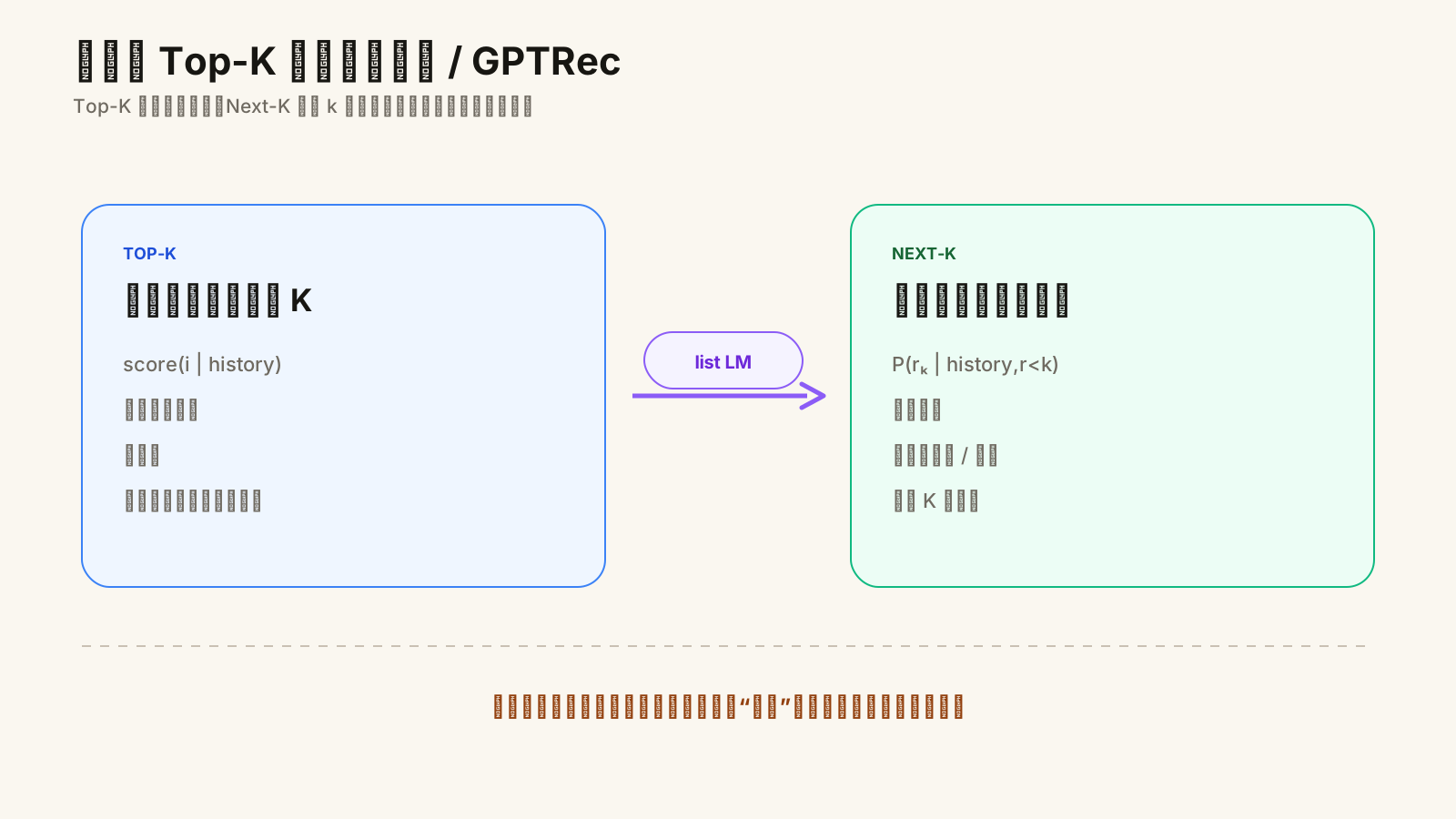
Figure 1. Top-K scores candidates in parallel; every Next-K decision conditions on the list prefix already generated.
List conditioning with eight items
Our user history remains:
I01 tennis racket → I03 climbing shoes
→ I05 badminton racket → I07 swim cap
Top-K might independently assign:
I06 goggles       0.92
I08 sports towel  0.89
I02 tennis balls  0.87
Next-K instead generates:
step 1: P(I06 | history)
step 2: P(I08 | history, I06)
step 3: P(I04 | history, I06, I08)
Step two can use the fact that goggles are already present; step three can cover climbing. The architecture creates a channel for list interaction. It does not automatically create diversity: if training still rewards only ordinary next-item likelihood, the model may continue copying popular or similar items.
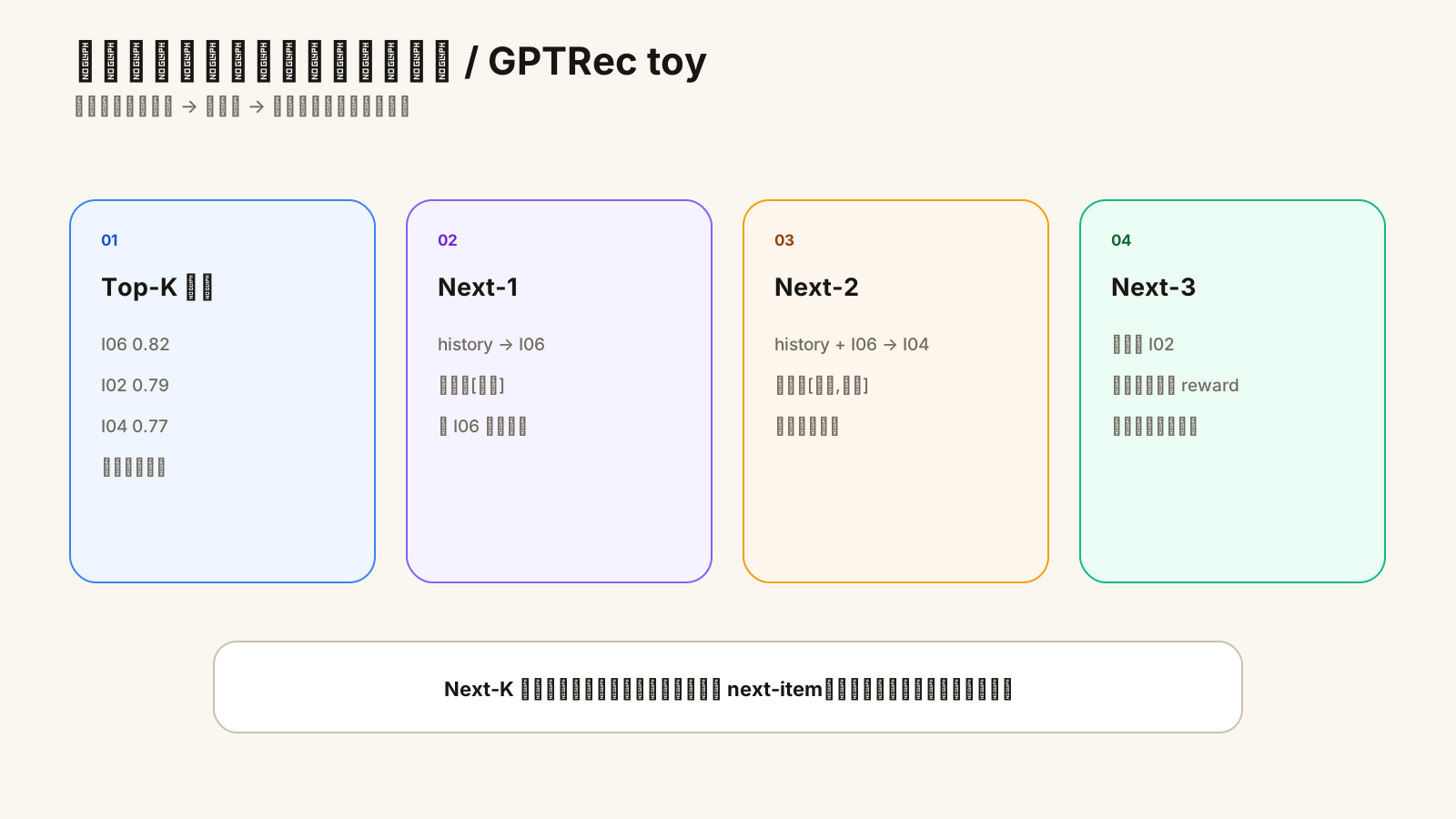
Figure 2. Next-K can express a list policy, but actual diversity requires data, objectives, or reinforcement signals that reward it.
A second route to item tokens: SVD quantization
TIGER learns Semantic IDs from content embeddings. GPTRec proposes a direct collaborative compression based on the user–item matrix.
For (M\in\mathbb R^{|U|\times|I|}), compute a truncated decomposition:
[ M\approx U\Sigma E^\top. ]
(E_i\in\mathbb R^t) is item (i)'s collaborative coordinate. For each dimension:
- normalize item values to ([0,1]);
- add Gaussian noise with standard deviation (10^{-5}) to break boundary ties;
- quantize into (v) bins;
- offset dimension (d)'s token range by (v(d-1)).
With (t=4,v=512), every product has four tokens but the model stores only (4\times512=2048) embeddings, independent of item count:
I06 goggles → 〈dim1-117, dim2-403, dim3-026, dim4-288〉
These are not content semantics. They discretize collaborative coordinates, so items consumed by similar users tend to have related patterns.
The central equation
For history (H) and list (R=(r_1,\ldots,r_K)), Next-K factorizes:
[ P(R\mid H) =\prod_{k=1}^{K} P(r_k\mid H,r_{<k}). ]
- (r_1) sees history only;
- (r_2) also sees the first recommendation;
- (r_{<k}) is the generated list prefix;
- order is therefore part of the distribution.
With atomic IDs, each (r_k) is one token. With SVD IDs, it expands into (t) subtokens. The latter saves item embeddings but requires more autoregressive steps.
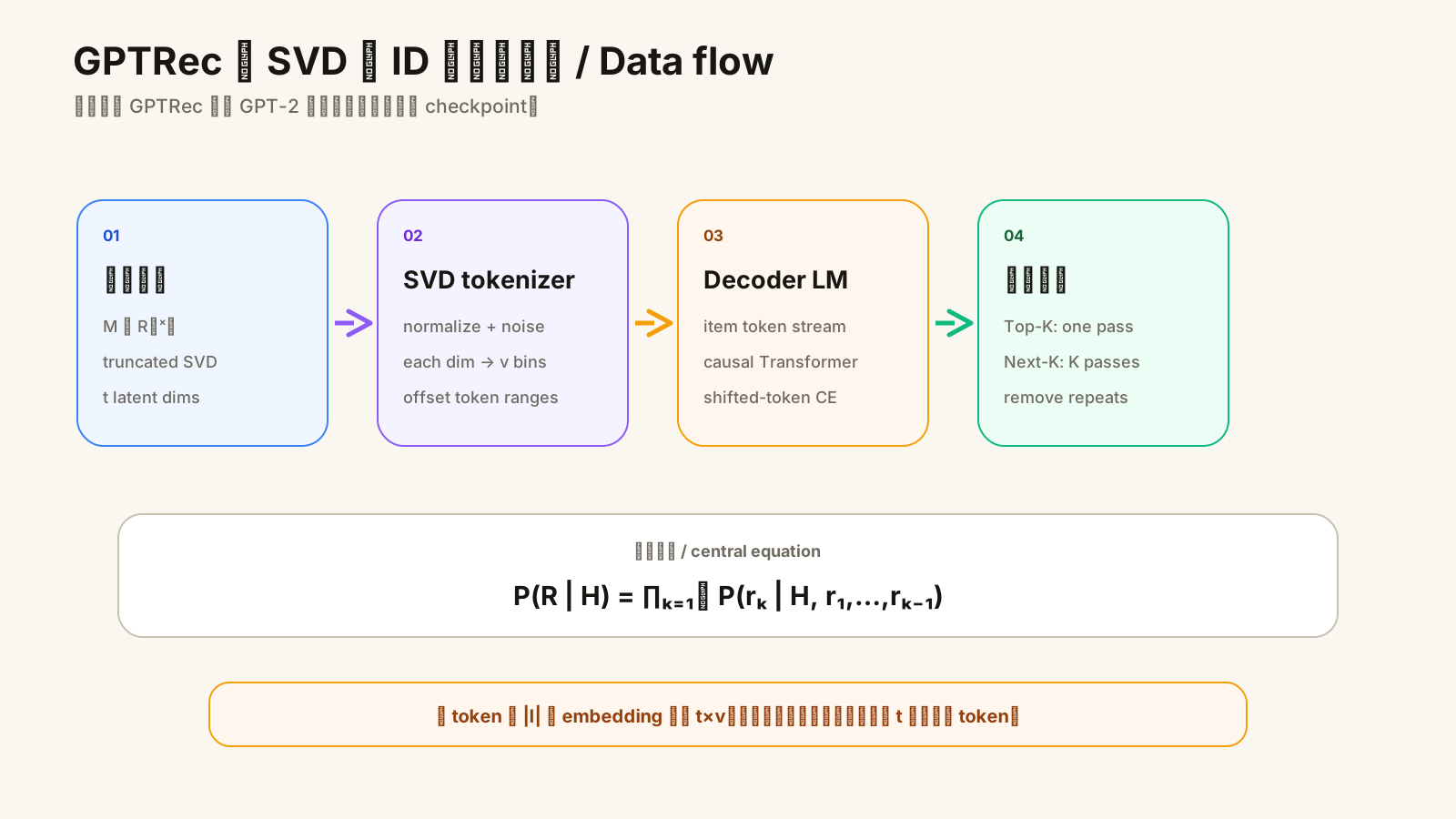
Figure 3. Item compression and list factorization are orthogonal axes: one-token Next-K and multi-token Top-K are both possible.
Training and inference
Top-K
Read the final hidden state, score it against all item embeddings once, and return the largest K logits. This resembles SASRec.
Next-K
Append each output to the context and score the next item. A ten-item list takes roughly ten scoring passes; multi-token items require still more decoder steps.
context = user_history
for k in 1..K:
    item = decode_one_item(context)
    result.append(item)
    context.append(item)
The paper's training remains based on observed next items rather than a mature list-level RL or diversity objective. Next-K is an expressive parameterization, not evidence that list utility has already been optimized.
What the experiments establish
The evidence comes from MovieLens-1M alone. Table 3 reports:
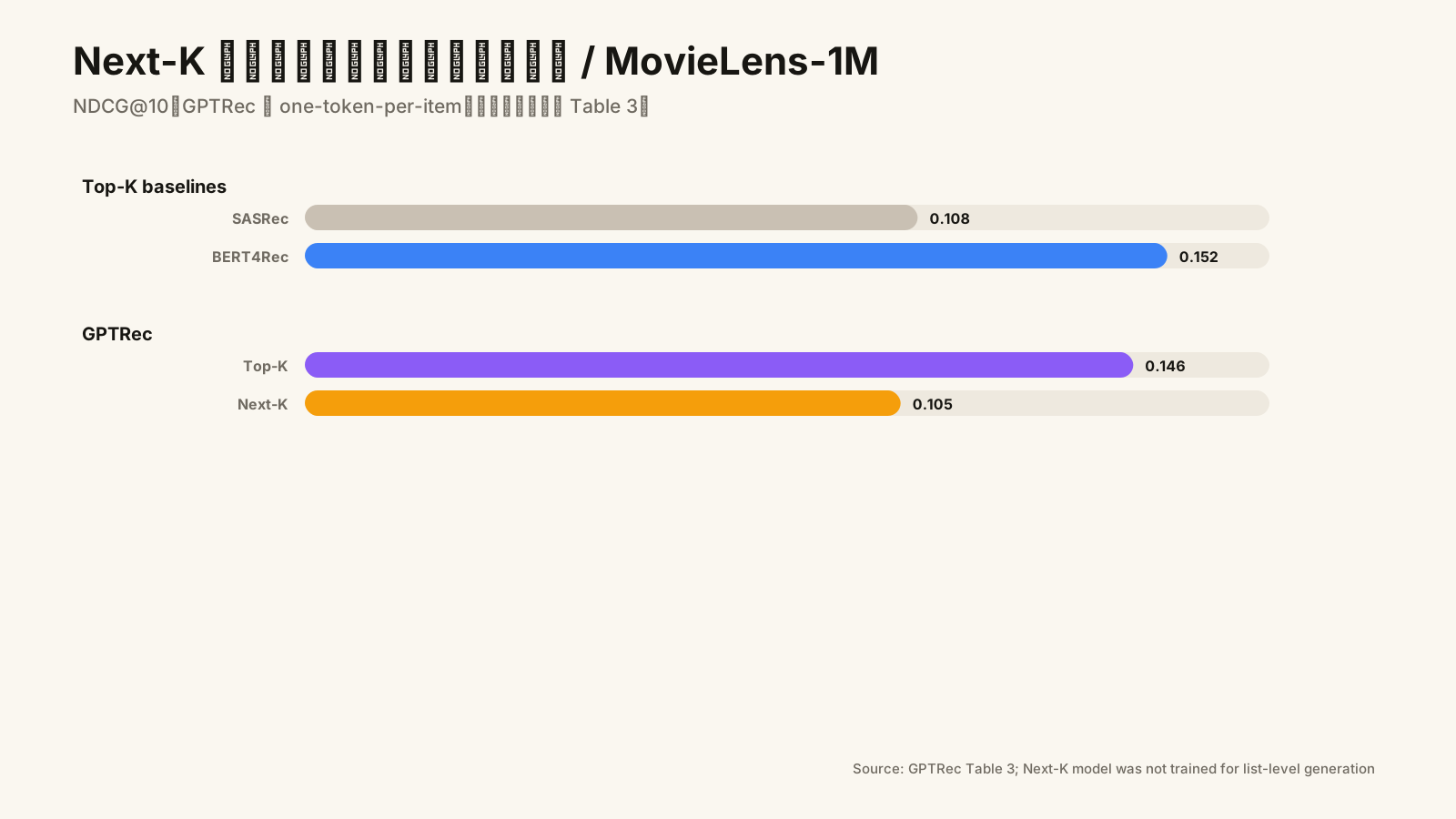
Figure 4. Top-K approaches the strongest baseline; Next-K pays a substantial accuracy cost for conditional list modeling.
| Method | NDCG@10 | Recall@10 |
|---|---|---|
| BERT4Rec | 0.152 | 0.282 |
| GPTRec-TopK | 0.146 | 0.254 |
| SASRec | 0.108 | 0.199 |
| GPTRec-NextK | 0.105 | 0.157 |
Next-K retains roughly 72% of Top-K NDCG, summarized by the authors as about 75%, while matching SASRec's NDCG. Sequentializing the list is not free: early errors contaminate later conditions.
Multi-token experiments expose a capacity–quality trade-off:
| Representation | Embeddings | NDCG@10 | Recall@10 |
|---|---|---|---|
| One token per item | 3,416 | 0.146 | 0.254 |
| 2 tokens × 2,048 values | 4,096 | 0.124 | — |
| 4 tokens × 512 values | 2,048 | 0.108 | 0.182 |
The four-token version uses about 40% fewer embeddings than the 3,416 atomic item embeddings and matches SASRec NDCG. Two tokens with larger bins perform better. A prose sentence in the paper appears to call the one-token NDCG 0.253; this chapter uses Table 3's 0.146.
Where GPTRec breaks
Expressivity is not an objective
Next-K permits later items to depend on earlier ones, but likelihood training mainly rewards relevance. Coverage, diversity, and long-term satisfaction must still be measured and optimized.
Autoregressive error accumulation
An incorrect first recommendation becomes part of step two's context. Teacher forcing shows gold prefixes in training while inference sees model prefixes.
Latency grows with K
Top-K scores once; Next-K scores K times. Multi-token IDs multiply the number of decoding steps again.
SVD IDs have no content cold start
They come from interactions, so a new item has no reliable column coordinate. Recomputing SVD can also shift coordinates and quantization boundaries, creating address-version migrations.
Evidence is narrow
MovieLens-1M has only 3,416 items. It does not demonstrate industrial scaling for either multi-token output or Next-K serving.
Why LC-Rec comes next
We now have two item languages:
- TIGER: content-based Semantic IDs, useful for semantics and cold start;
- GPTRec-SVD: collaborative tokens from the interaction matrix.
Recommendation needs both. Textually similar products need not attract the same users, while collaboratively similar products may have unrelated names. LC-Rec, in the next chapter, combines a pretrained LLM, Semantic IDs, and collaborative alignment tasks—and introduces uniform semantic mapping to remove ID conflicts.
Critical takeaway: GPTRec separates two questions often conflated in generative recommendation: how to tokenize an item and how to factorize a list. It demonstrates that compact tokens and Next-K are feasible, while its accuracy and latency costs show that a generative interface merely enlarges the optimization space; the list objective still has to be specified.