If two products share three code prefixes, the generator treats them as neighbors. But what should “near” mean?
- similar titles?
- consumed by similar users?
- or merely squeezed together because the codebook collapsed?
LC-Rec connects a fixed item index to language and behavior through multitask tuning, but it does not directly specify what the tokenizer should optimize for recommendation. LETTER: Learnable Item Tokenization for Generative Recommendation reverses the question:
Before asking whether the generator is large enough, define what makes a good recommendation token.
It proposes three criteria: hierarchical semantics, collaborative signals, and code-assignment diversity.
The paper in 30 seconds
- LC-Rec's open problem: content reconstruction does not necessarily preserve collaborative neighbors, and a codebook may use only a small fraction of its entries.
- LETTER's answer: retain RQ-VAE semantic reconstruction, contrast quantized item representations with SASRec/LightGCN item embeddings, and regularize code clustering for diverse usage: (\mathcal L_{\rm Sem}+\alpha\mathcal L_{\rm CF}+\beta\mathcal L_{\rm Div}).
- The result: on Beauty, LETTER-TIGER reaches 0.0364 NDCG@10 versus TIGER's 0.0331. Collaborative regularization raises 0.0331 to 0.0351; collaboration plus diversity reaches 0.0357; ranking guidance reaches 0.0364.
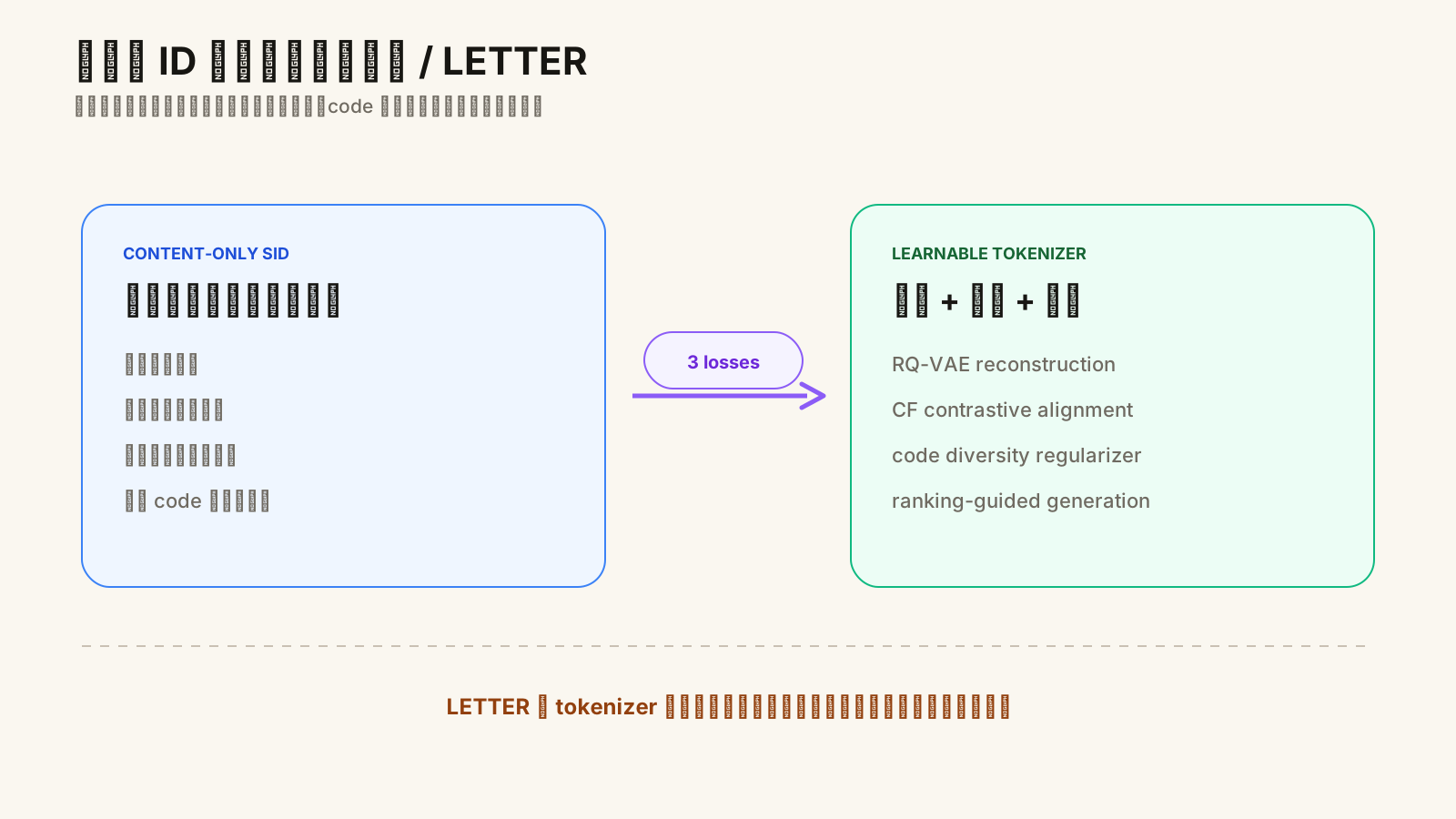
Figure 1. LETTER treats ID design as a multi-objective problem. Reconstructing content is not sufficient for prediction and ranking.
Three objectives in our eight-item catalog
Hierarchical semantics
I06 goggles and I07 swim cap may share:
I06 = 〈sports, water, swimming, eyes〉
I07 = 〈sports, water, swimming, head〉
RQ-VAE's residual reconstruction supplies this coarse-to-fine content structure.
Collaborative consistency
I03 climbing shoes and I04 chalk bag are not close in text, but co-occur in behavior. If their pretrained SASRec or LightGCN embeddings are close, LETTER wants their quantized representations to agree.
Assignment diversity
If six of eight items choose code 0 at level one, most entries receive no useful training and the generator faces a severely unbalanced branch. LETTER spreads assignments and separates different clusters.
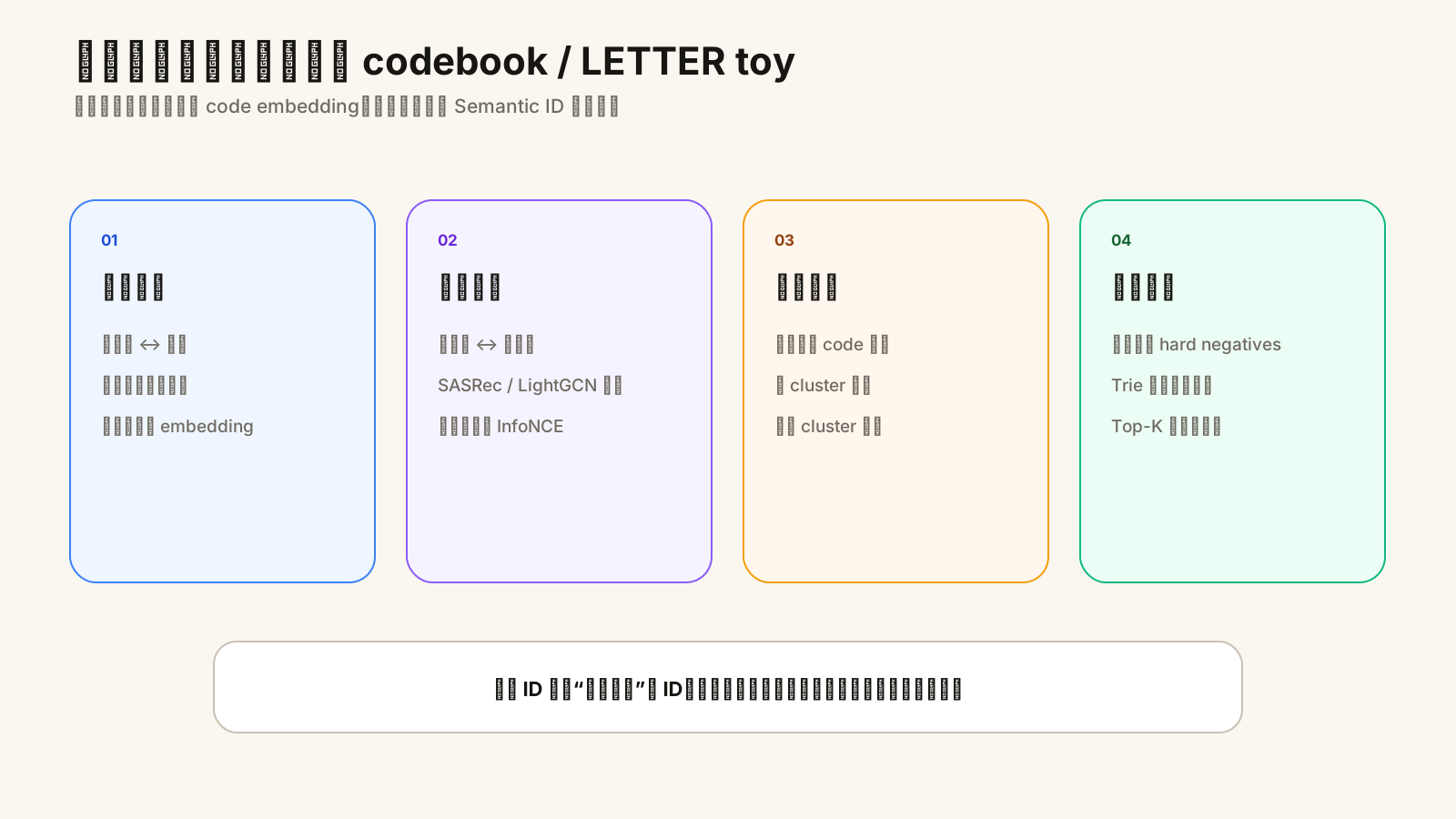
Figure 2. Semantics, collaboration, and balance can conflict. LETTER exposes that conflict to the objective instead of assuming quantization resolves it automatically.
The central equation
[ \mathcal L_{\text{LETTER}} =\mathcal L_{\text{Sem}} +\alpha\mathcal L_{\text{CF}} +\beta\mathcal L_{\text{Div}}. ]
(\mathcal L_{\text{Sem}}): content
RQ-VAE reconstruction, codebook, and commitment losses keep quantized (\hat z_i) close to content representation (z_i) and form residual codes from coarse to fine.
(\mathcal L_{\text{CF}}): collaborative alignment
A conventional collaborative model supplies item embedding (h_i). In a batch, ((\hat z_i,h_i)) is positive and other items are negatives:
[ \ell_i^{z\to h} =-\log \frac{\exp(\operatorname{sim}(\hat z_i,h_i)/\tau)} {\sum_j\exp(\operatorname{sim}(\hat z_i,h_j)/\tau)}. ]
The bidirectional contrastive loss does not require identical spaces; it makes collaborative neighborhoods recoverable in the quantized space.
(\mathcal L_{\text{Div}}): code diversity
LETTER applies constrained k-means-style regularization over code embeddings: samples assigned to one cluster are pulled together, different clusters are separated, and cluster capacity is restricted. This is not merely about unique item IDs. It asks whether the vocabulary is effectively used.
The weights encode a genuine trade-off. Excessive (\alpha) can overfit historical interactions and weaken content cold start; excessive (\beta) can destroy naturally unbalanced semantic clusters.
From tokenizer to recommender
LETTER is a tokenizer that can be inserted into different generative backbones. The paper replaces the original tokenizers of both TIGER and LC-Rec:
item content ─┐
              ├→ LETTER tokenizer → Semantic IDs
CF embedding ─┘                          ↓
                                    TIGER / LC-Rec
The tokenizer is trained offline, frozen, and then used to rewrite histories for generator training.
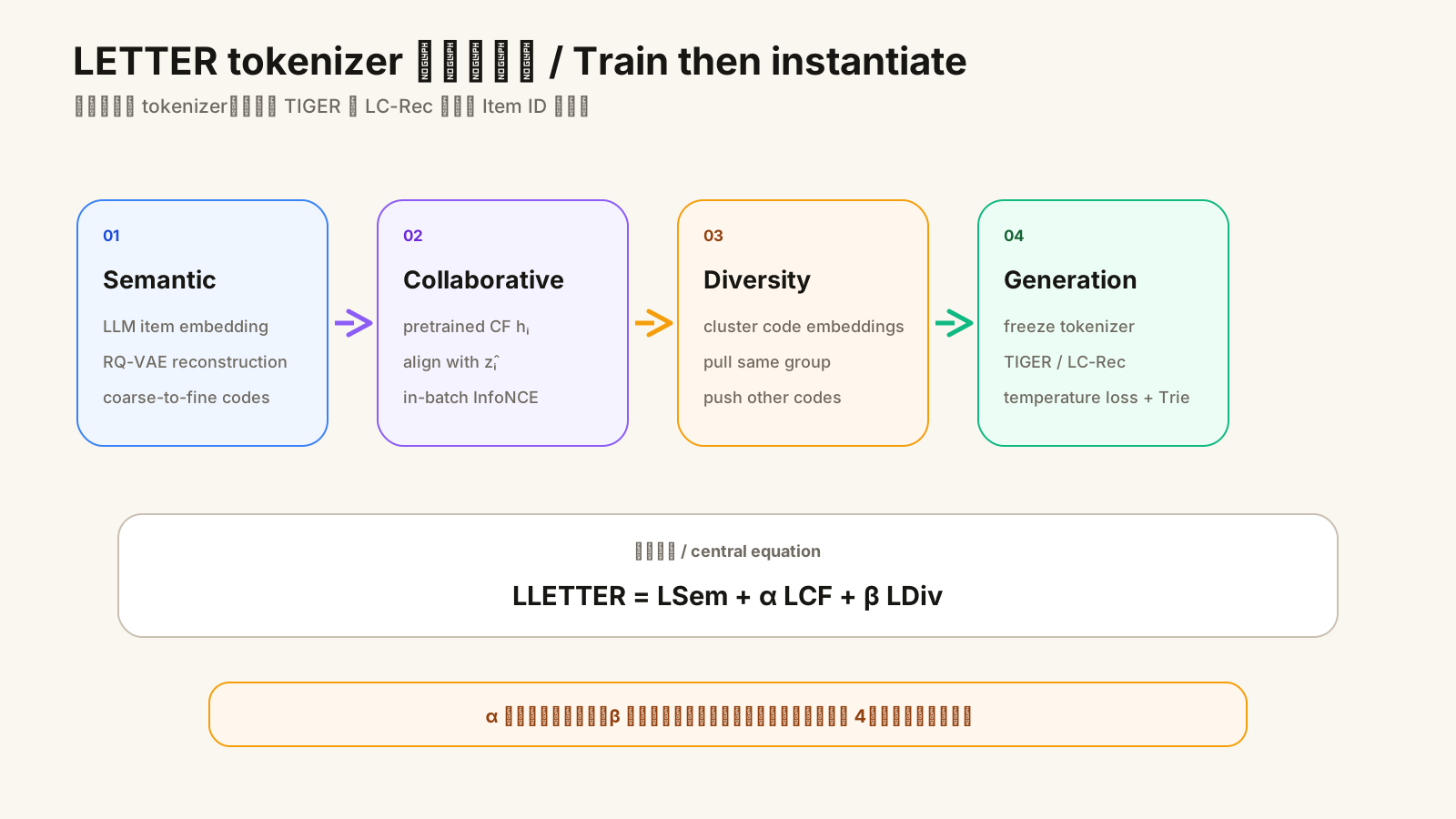
Figure 3. LETTER improves the vocabulary and can transfer across backbones, but the two-stage mismatch remains.
What ranking-guided generation changes
Token cross-entropy treats the gold code as positive and every wrong code as negative. Ranking instead cares disproportionately about candidates that might enter Top-K. LETTER changes decoding temperature (\tau); lower temperature concentrates probability on hard, high-scoring negatives and emphasizes their margin against the positive.
The paper connects the formulation to one-way partial AUC. Intuitively:
do not push every negative equally;
focus on the negatives that can actually displace the target.
Inference uses trie-constrained generation so only catalog IDs remain legal.
Training and inference
1. Train SASRec or LightGCN and store h_i
2. Encode item content into z_i
3. Train LETTER with Sem + αCF + βDiv
4. Freeze the tokenizer and convert every history to IDs
5. Train TIGER or LC-Rec with ranking guidance
6. Return valid items through trie-constrained beam search
This is more capable than TIGER and operationally more involved: a conventional recommender becomes the tokenizer's teacher, while the content encoder, RQ-VAE, generator, three losses, and decoding temperature all have lifecycle dependencies.
What the experiments establish
LETTER is tested with both TIGER and LC-Rec:
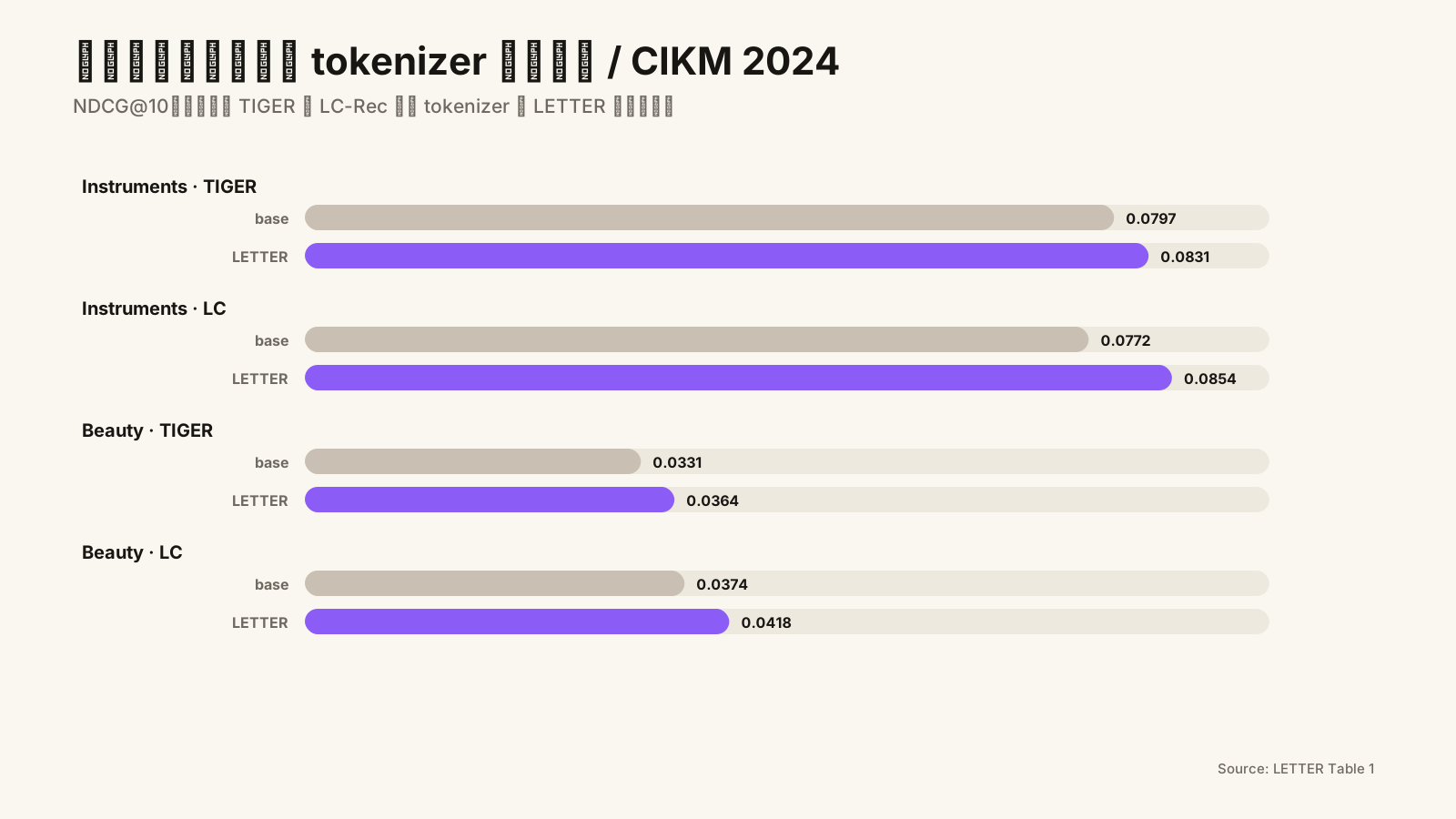
Figure 4. Gains across two backbones and three datasets suggest that the tokenizer—not one special generator—is responsible.
| Backend | Dataset | Original | + LETTER |
|---|---|---|---|
| TIGER | Instruments | 0.0797 | 0.0831 |
| TIGER | Beauty | 0.0331 | 0.0364 |
| TIGER | Yelp | 0.0213 | 0.0231 |
| LC-Rec | Instruments | 0.0772 | 0.0854 |
| LC-Rec | Beauty | 0.0374 | 0.0418 |
| LC-Rec | Yelp | 0.0199 | 0.0211 |
The Beauty/TIGER ablation separates the effects:
| Components | NDCG@10 |
|---|---|
| TIGER tokenizer | 0.0331 |
| + collaborative regularization | 0.0351 |
| + diversity regularization | 0.0335 |
| + both | 0.0357 |
| + ranking-guided loss | 0.0364 |
Diversity alone adds little but complements collaboration. The paper also measures collaborative similarity among code neighbors: TIGER scores 0.0849/0.1135, while LETTER reaches 0.2760/0.3312. The address structure really changes rather than the generator merely getting lucky.
Identifier length improves from two to four tokens and then declines at eight. More levels increase capacity but lengthen the autoregressive path; one incorrect component invalidates the complete address.
Where LETTER breaks
Tokenizer and generator are still separate
The collaborative teacher narrows the objective mismatch, but the final generator's loss cannot directly modify the tokenizer.
It depends on a conventional teacher
Popularity, exposure, and stale-distribution biases in SASRec or LightGCN embeddings become part of the ID. The generative model inherits rather than escapes the conventional recommender.
Objectives can fight
Natural semantic clusters are often unbalanced. Forced balance can split real categories, while collaborative neighborhoods change with seasonality and policy. One pair of (\alpha,\beta) values may not fit the entire catalog.
Addresses drift
Retraining the collaborative teacher or tokenizer changes IDs. Behavior evolves faster than content, potentially making version migration more frequent.
Evidence remains medium-scale
Consistent gains are encouraging, but code balance, trie decoding, and the multistage pipeline are not demonstrated over tens of millions of items or real-time feedback.
Why ETEGRec comes next
LETTER writes collaboration into the tokenizer but still follows:
learn and freeze IDs → train a generator to adapt
If the generator finds a code difficult to predict from history, it cannot ask the tokenizer to change the address. The tokenizer cannot see how the generator currently represents a user. ETEGRec, in the next chapter, adds two cross-model alignment objectives and alternates updates so the item language and user model co-evolve.
Critical takeaway: LETTER elevates item IDs from preprocessing to a testable modeling object. Its most durable contribution is not two extra losses, but three questions for any Semantic ID: what content does it retain, what behavior does it retain, and is its vocabulary actually used?