GenRec generates a page of content. GR4AD enters advertising, where another objective becomes unavoidable:
Does the generated slate create an executable commercial result across budgets, bids, user experience, and platform revenue?
Advertising is not ordinary recommendation with one extra price feature. State changes quickly, value objectives are strong, audit requirements are higher, and decoding latency must fit the main serving path.
Understand the paper in 30 seconds
- The old problem: retrieval, pre-ranking, ranking, and re-ranking optimize separately; content-oriented SIDs do not encode bids, value, or advertising state.
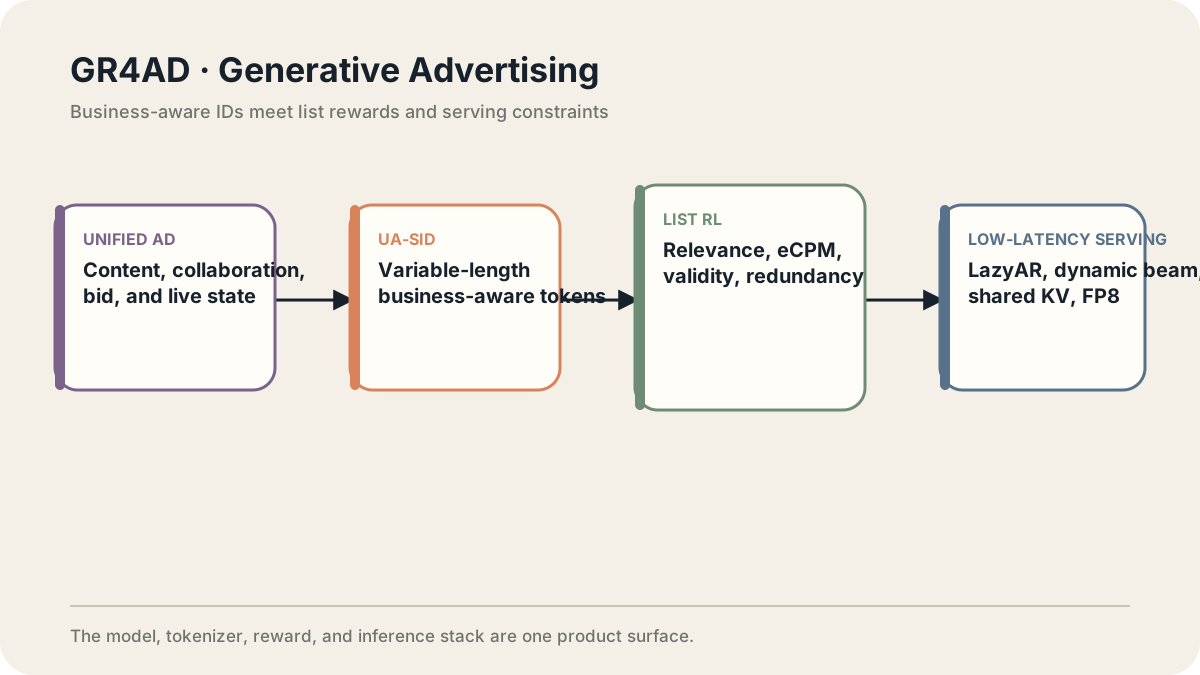
- GR4AD's answer: learn business-aware UA-SIDs, optimize the full slate, and use LazyAR, variable sequence length, dynamic beam search, shared KV cache, FP8, and caching to control serving cost.
- Industrial evidence: the paper reports service at more than 400 million users, sub-100-ms latency, over 500 QPS on one L20 GPU, and advertising revenue lift. The results are powerful, but the private logs, baselines, and attribution are not externally reproducible.
Why a content SID is insufficient
Two running shoes may be visually similar, while the advertising system also needs:
- bid and payment willingness;
- remaining budget;
- predicted click and conversion;
- creative freshness and review status;
- current commercial objective.
A content-only SID generates an ad that looks relevant, not necessarily one that is eligible and valuable now.
GR4AD's Unified Advertisement representation combines content, collaborative, and business signals before quantization into UA-SIDs. The generated token itself carries advertising context instead of relying entirely on downstream rules.
How list value enters training
An advertising slate is not simply the sum of independent ad scores. Repeated brands, similar creatives, and budget competition create interactions.
A simplified reward is:
[ R(A_{1:K})
\sum_{j=1}^{K} \left( \alpha,\widehat{\mathrm{CTR}}_j + \beta,\widehat{\mathrm{CVR}}_j + \gamma,\mathrm{eCPM}j \right) -\lambda,\mathrm{Redundancy}(A{1:K}). ]
List-level reinforcement learning makes the model responsible for the slate. The danger is equally clear: a reward model is not the market. Aggressive short-term revenue optimization may damage user experience, advertiser fairness, or long-term ecosystem health.
Why serving design matters as much as the model
Autoregressive decoding pays for tokens sequentially. At advertising scale, every additional token becomes GPU cost. GR4AD combines several techniques:
- LazyAR avoids paying early for computation that can be delayed or parallelized.
- Variable sequence length gives simpler ads shorter IDs.
- Dynamic beam adjusts search width by request uncertainty.
- Shared KV cache reuses common prefix computation.
- Top-K pruning, FP8, and result caching improve throughput further.
Industrial generative recommendation is therefore not a larger Transformer attached to an endpoint. Tokenizer, model, search, and serving architecture must be co-designed.
Why online numbers still require restraint
The paper reports roughly 4.2% advertising revenue lift along with efficiency results. This supports the industrial value of the system, but does not isolate:
- the contribution of UA-SID;
- RL versus serving improvements;
- robustness across seasons and advertiser segments;
- exposure fairness for small advertisers;
- long-term user retention.
The greatest value of an industrial paper is evidence that the system can remain alive under real traffic. Its weakest point is that an external team cannot rebuild the same market and feedback loop.
Where it fails
Several governance questions remain underdeveloped:
- How is a business-aware SID audited when it encodes the wrong value?
- Does the system systematically favor large-budget advertisers?
- How do caches stay consistent with second-level ad updates?
- Can the platform explain why a particular ad received exposure?
- Are revenue objectives bounded by user-experience and compliance guardrails?
The season has now covered representation, reasoning, continuous generation, product creation, page generation, and advertising deployment. One foundational question remains:
When aggregate metrics rise, is the generative model truly generalizing?
The final paper, How Well Does Generative Recommendation Generalize?, splits the test set to see whether the model combines new patterns or merely remembers at another granularity.