The first six papers kept adding capabilities: learnable IDs, structured reasoning, continuous representations, product creation, page generation, and advertising deployment. The final step is to stop and ask:
Does a higher aggregate NDCG reflect a new capability, or merely a test set with more examples suited to that model?
How Well Does Generative Recommendation Generalize? does not propose a larger generator. It reorganizes the evidence. The paper compares Atomic Item ID and Semantic ID models and finds that they excel on different kinds of examples.
Understand the paper in 30 seconds
- The common story: SIDs share semantic tokens, so a model can compose known tokens to predict rare or unseen item transitions.
- The diagnosis: test cases should be separated into memorization-heavy and composition-heavy regimes. Generative models tend to be stronger on the latter, while Atomic ID models can dominate the former.
- The sharpest result: an unseen item-level transition may still consist of heavily observed token-level transitions. What looks like generalization may be token-level memorization.
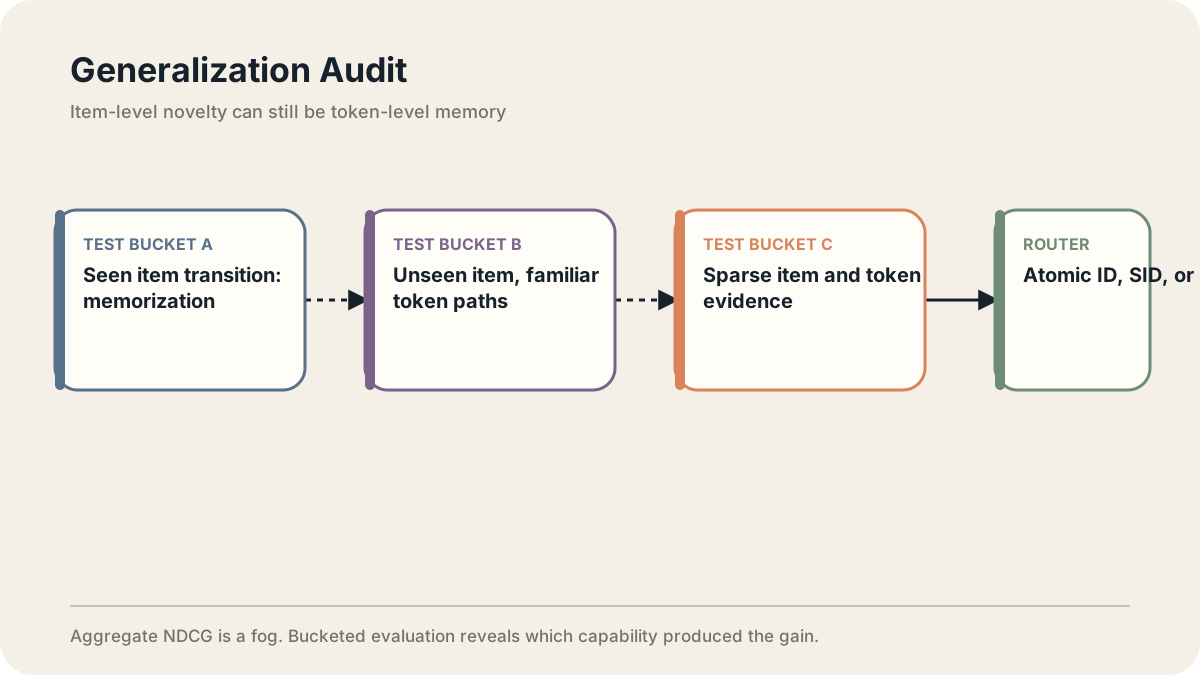
How to split the test set
Suppose training contains:
climbing shoes → chalk
swim cap → quick-dry towel
A test example asks for:
climbing shoes → quick-dry towel
The complete item transition is unseen. Yet if the items share tokens such as <sport> and <gear>, the model may have observed the underlying token transitions many times.
At least three buckets are useful:
- Item memorization: the complete source-to-target transition appears in training.
- Token composition: the full item transition is unseen, but its token-level pieces are familiar.
- Sparse generalization: even the important token combinations are rare or unseen.
Aggregate NDCG hides the mixture of these buckets.
Why SASRec and TIGER can be complementary
Atomic IDs give each item independent parameters. They transfer poorly to unseen items, but they can remember frequent concrete transitions precisely.
SID models share tokens. They sacrifice some exact memory in exchange for shared statistics and composition.
Let:
[ s_{\text{atomic}}(i\mid H_u),\qquad s_{\text{sid}}(i\mid H_u) ]
be their scores. A fixed average is crude. The paper studies adaptive blending based on memorization signals:
[ s(i\mid H_u)
\alpha(H_u)s_{\text{atomic}} + (1-\alpha(H_u))s_{\text{sid}}. ]
When the request resembles an observed transition, the Atomic ID model receives more weight. When composition is needed, the SID model receives more weight. The conclusion is not permanent replacement, but conditional trust.
What this changes about evaluation
Future generative recommendation papers should report:
- how many test transitions appeared in training;
- whether a “cold” item is unseen only at item level or also at token level;
- whether random splitting leaks future transition structure;
- whether full-catalog and sampled evaluation are mixed;
- which bucket produces the aggregate gain;
- whether improvements are statistically meaningful within each bucket.
Two models can reach a similar total score through very different capability profiles. A distribution shift can reverse their ranking.
What the paper does not prove
The analysis centers on representative Atomic ID and SID systems. It cannot automatically be generalized to DIGER, ContRec, page-level RL, or industrial advertising models.
Composing an unseen transition is also not full open-world generalization. Real systems face:
- new items and categories;
- temporal drift and fashion cycles;
- cross-market transfer;
- price, inventory, and policy shocks;
- sudden preference changes.
A stricter protocol would control time, item novelty, and token novelty simultaneously.
The conclusion of Season 2
The seven papers expand the field in different directions:
- DIGER asks whether recommendation loss can rewrite IDs.
- CARE asks how prefix errors cascade.
- ContRec asks whether discrete SIDs are necessary.
- DualFashion asks whether recommendation can create products.
- GenRec changes the training unit to a page.
- GR4AD moves generation into the advertising mainline.
- The generalization audit asks what the reported gains actually mean.
Together they support a more mature view:
Generative recommendation is not one model. It is a set of choices about representation, decoding, objectives, systems, and evidence.
Season 2 ends here, but the next research directions are already visible: dynamic item languages, verifiable recommendation reasoning, long-term feedback, open-world cold start, and request-level cooperation between Atomic ID and generative models.
Previous: GR4AD · Back to the Season 2 roadmap · Back to Season 1