The first four papers focused on representation, reasoning, and what may be generated. GenRec returns to the real application surface:
When a user scrolls, the system needs a page, not a single next item.
The same history can support many reasonable pages. If every clicked item becomes the unique label for the same input, a normal multi-answer problem looks like contradictory supervision. GenRec makes the page itself the unit of learning.
Understand the paper in 30 seconds
- The old problem: next-item training ignores order, complementarity, repetition, and diversity within a list. Long histories serialized as multi-token SIDs also consume context and compute.
- GenRec's answer: Page-wise Generation predicts a full page; Token Merger compresses history; GRPO-SR aligns relevance, validity, and preference through page-level rewards.
- The important evidence: the paper reports large-scale deployment and a month-long online experiment. The evidence is valuable, while private data, reward models, and internal baselines limit independent verification.
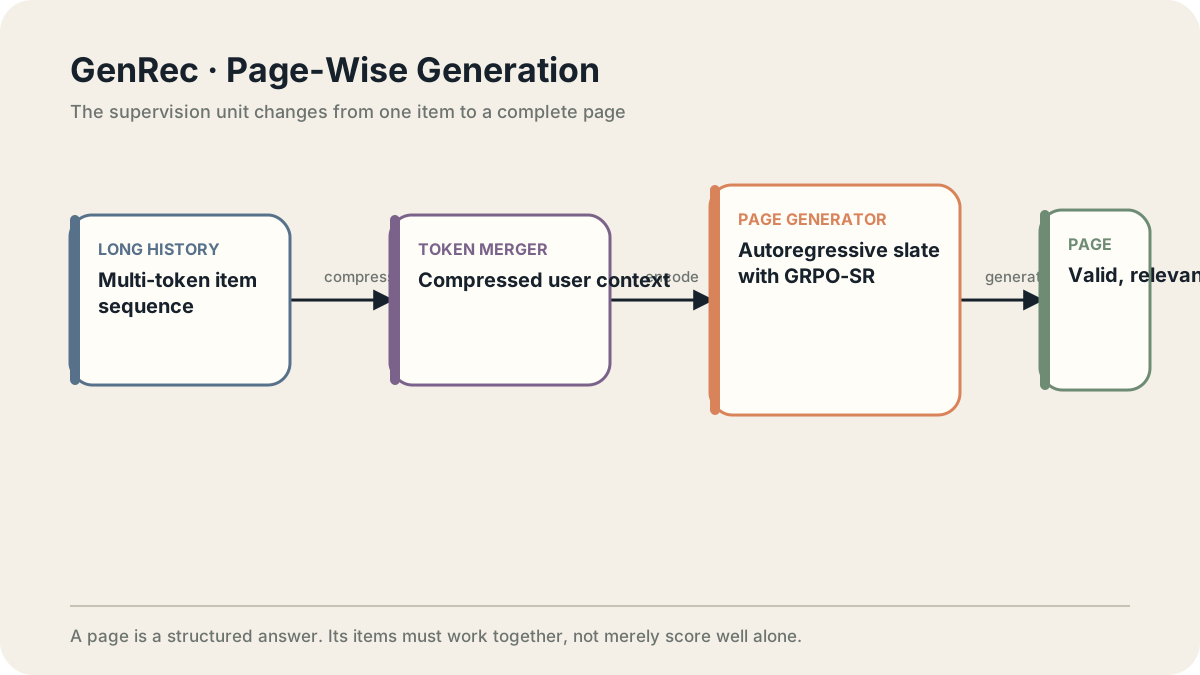
Why point-wise supervision conflicts
Suppose a sports page displays and receives engagement on:
climbing shoes → chalk → quick-dry towel → swim cap
Four separate next-item samples would ask the same history to have four different unique answers. Page-level supervision preserves the fact that the products formed one presentation and that their order and co-occurrence carry policy information.
The objective becomes:
[ p(S_u\mid H_u)
\prod_{j=1}^{|S_u|} p(i_j\mid H_u,i_{<j}), ]
where (S_u) is the complete page. Later items depend on earlier generated items, so the model can learn de-duplication, complementarity, and page rhythm.
What Token Merger compresses
If every historical item is represented by several SID tokens, hundreds of actions become thousands of tokens. Token Merger combines local item or history tokens into a more compact representation.
The compression mainly reduces history encoding. The page still requires autoregressive output. When a paper says token count is halved, ask whether it halves the prompt, KV cache, or final decoding steps. These are not interchangeable savings.
Why reinforcement learning is still needed
Supervised learning imitates logged pages. It does not know whether a newly generated page is good. GRPO-SR compares sampled pages with a page-level reward that can be simplified as:
[ R(S)=R_{\text{valid}} + \mathbb 1[R_{\text{valid}}>0] \left( \alpha R_{\text{relevance}} +\beta R_{\text{preference}} +\gamma R_{\text{diversity}} \right). ]
The validity gate matters. A page containing illegal items, severe repetition, or broken structure should not compensate with a high relevance score. The gate blocks a common form of reward hacking.
Reward design also writes platform values into the model. Different weights on relevance, long-tail exposure, conversion, and satisfaction produce different pages.
How to read the online result
The paper reports gains in clicks, transactions, and long-tail outcomes and describes deployment in a large application. That supports the value of the complete system, not necessarily every module in isolation.
A production change often includes:
- page labels and sample construction;
- tokenizer and multimodal features;
- model scale;
- RL reward;
- beam search, caching, and filtering;
- traffic policy and catalog eligibility.
The online A/B test proves that the package can work. Module ablations are still needed to identify what transfers elsewhere.
Where it fails
Page generation faces three hard issues:
- Multiple valid answers: logs reveal one exposed page, not all good pages.
- Policy bias: clicks come from an old exposure policy and may reproduce its blind spots.
- Decoding constraints: inventory, duplication, compliance, and live state must be enforced during or after generation.
GenRec shows that page-level generation can enter production. Advertising adds budgets, bids, expected revenue, and competition.
The next paper, GR4AD, puts the generator into the advertising mainline, where each token can change revenue directly.