ContRec still maps its generated vector back to an existing catalog. DualFashion crosses that boundary:
If the catalog does not contain what the user wants, can the recommender draw it?
Recommendation now becomes part of product design. DualFashion generates a fashion image and a structured text description together. That forces us to distinguish three different claims: the output looks suitable, the description is coherent, and the product can actually be sold.
Understand the paper in 30 seconds
- The old problem: many generative fashion recommenders output only images, while visual histories also contain background, pose, and photography noise.
- DualFashion's answer: one diffusion branch generates the garment image, another generates structured attributes, and the branches condition each other.
- The hard boundary: visual quality and compatibility do not prove manufacturability, inventory, pricing, safety, or copyright clearance.
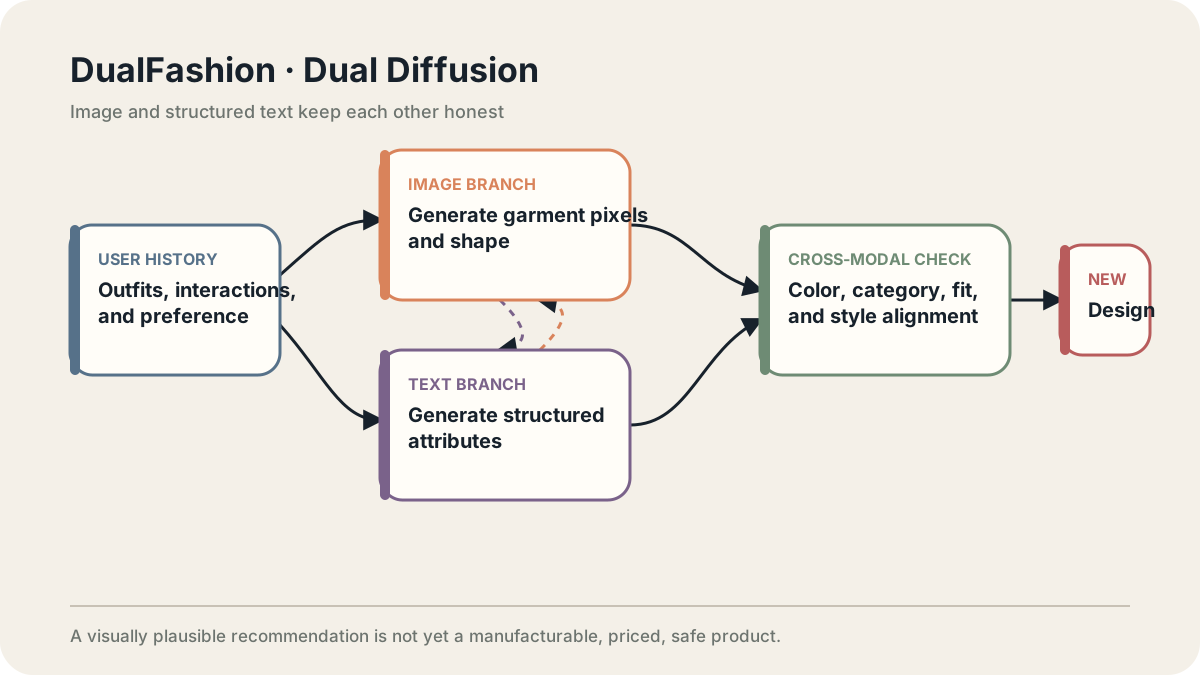
A missing outfit item makes the task concrete
Suppose a user history contains:
white tennis skirt → black climbing trousers → blue swimsuit
The system must complete an outfit around a light-gray sports jacket. A catalog recommender retrieves an existing pair of trousers. DualFashion may generate:
- an image of navy, straight-fit, quick-dry trousers;
- a structured caption such as
category=trousers, color=navy, fit=straight, fabric=quick-dry.
The text branch is not decoration. It turns the image into inspectable attributes and discourages the image model from optimizing only for fashion-photography aesthetics.
How the two diffusion branches cooperate
Let user history be (h_u), image latent be (x_0), and text representation be (z_0). The branches denoise in parallel:
[ \hat\epsilon_x=f_\theta(x_t,t,h_u,z_t), \qquad \hat\epsilon_z=g_\phi(z_t,t,h_u,x_t). ]
A simplified objective is:
[ \mathcal L= \mathcal L_{\text{image}} +\lambda\mathcal L_{\text{text}} +\mu\mathcal L_{\text{align}}. ]
The image branch reads text state, and the text branch reads image state. Their alignment objective asks the generated picture and description to agree on category, color, style, and other attributes.
Why structured captions matter
Free-form prose can sound convincing while remaining impossible to audit. Structured captions create finite fields that support:
- attribute coverage;
- image-text consistency;
- compatibility and personalization;
- diversity and duplication checks;
- evidence tracing back to user history.
The paper studies tasks such as personalized fill-in-the-blank and generative outfit recommendation on fashion datasets including iFashion and Polyvore-U.
This is closer to recommendation than a single CLIP score, but it still does not close the commercial loop. CLIP can say an item looks appropriate; a factory may still be unable to produce it.
Why the metrics should not be collapsed
DualFashion combines recommendation and generation:
- Recommendation quality: user fit and outfit compatibility.
- Generation quality: image realism, diversity, and textual accuracy.
Metrics such as IS, LPIPS, compatibility, personalization, CLIP alignment, and attribute entropy measure different things. One model may create more attractive images that fit the user less. Another may personalize strongly while copying training designs.
A stronger evaluation would also check near-duplicates, intellectual-property risk, blind user preference between catalog and generated options, and whether a generated design can move into production.
Where it fails
DualFashion leaves the hardest product constraints outside the model:
- manufacturability and fabric behavior;
- sizing, cost, and supply-chain feasibility;
- brand and design rights;
- whether the caption faithfully describes the image;
- whether users want to buy rather than merely look.
Once a recommender generates the product, offline ranking accuracy is no longer the main metric. The system needs a chain from preference to design, review, production, and feedback.
The next paper, GenRec, returns to large-scale online recommendation, but the output has also changed: the model generates a complete page rather than one next item.