An LLM knows that The Godfather is a crime film and Iron Man is a superhero film. It can explain their directors, eras, and themes.
Now tell it:
This user likes The Godfather and dislikes Star Wars.
Will the user like Iron Man?
Is it predicting this person, or repeating what people generally like?
M6-Rec, the previous paper, demonstrates the industrial potential of a pretrained language foundation. Its large system and in-domain data make one question hard to isolate: how much recommendation ability does general language pretraining provide by itself?
TALLRec: An Effective and Efficient Tuning Framework to Align Large Language Model with Recommendation runs a clean experiment:
Prompting a general LLM directly leaves recommendation near random; convert a small amount of preference data into instructions and tune with LoRA, and the capability appears.
TALLRec shifts the 2023 LLM-for-recommendation vocabulary from prompting to alignment.
Understand the paper in 30 seconds
- M6-Rec’s open question: a foundation trained inside a large industrial stack can work, but that does not mean a general LLM naturally predicts individual preference.
- TALLRec’s answer: first use Alpaca instructions to retain general instruction following; then format recommendation logs as “history + target item → Yes/No.” Both stages update only low-rank LoRA parameters.
- The decisive evidence: with 64 Movie examples, the best baseline has AUC×100 of 51.71 and TALLRec reaches 67.48. On Book, 50.06 becomes 60.39. Zero-shot LLM baselines remain near 0.5, exposing a real domain gap.
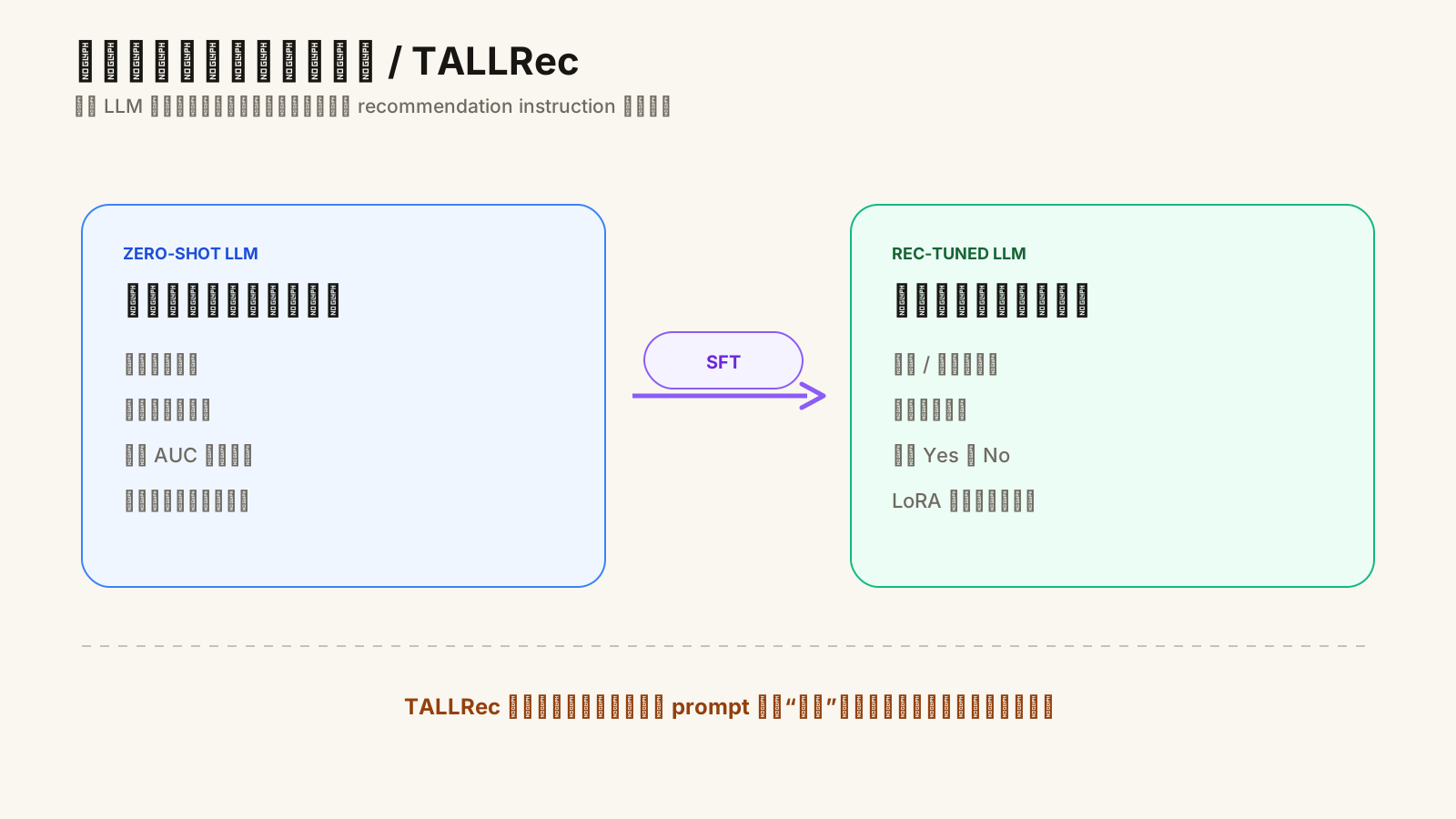
Figure 1. World knowledge can describe a product, but it does not automatically supply the supervision direction for “will this user like it?”
What problem did the previous paper leave behind?
General LLM pretraining mostly consumes web pages, books, code, and dialogue. Its canonical target is
A recommender needs
Both can be written as text, but they are not the same conditional distribution.
Language data can teach a model that goggles are swimming equipment or climbing shoes need grip. It rarely provides explicit supervision for why one person clicks an item and another does not, or how rating thresholds define an individual decision boundary.
With in-context prompting alone, an LLM may rely on popularity, commonsense, or item descriptions without learning the preference rule encoded in interaction logs.
Construct one rec-tuning example with eight items
TALLRec organizes a recommendation record into three parts.
1. Split history into liked and disliked items
Suppose Lin’s ratings produce:
liked:    I01 racket, I03 climbing shoes, I05 shuttlecock
disliked: I07 yoga mat
For Movie, ratings above 3 are likes and ratings at most 3 are dislikes. Book uses its own threshold.
2. Add an unseen target
target: I06 goggles
description: anti-fog goggles for swim training...
3. Supervise a binary response
Instruction:
Given the history, decide whether the user will like the target.
Answer only Yes or No.

Output:
Yes
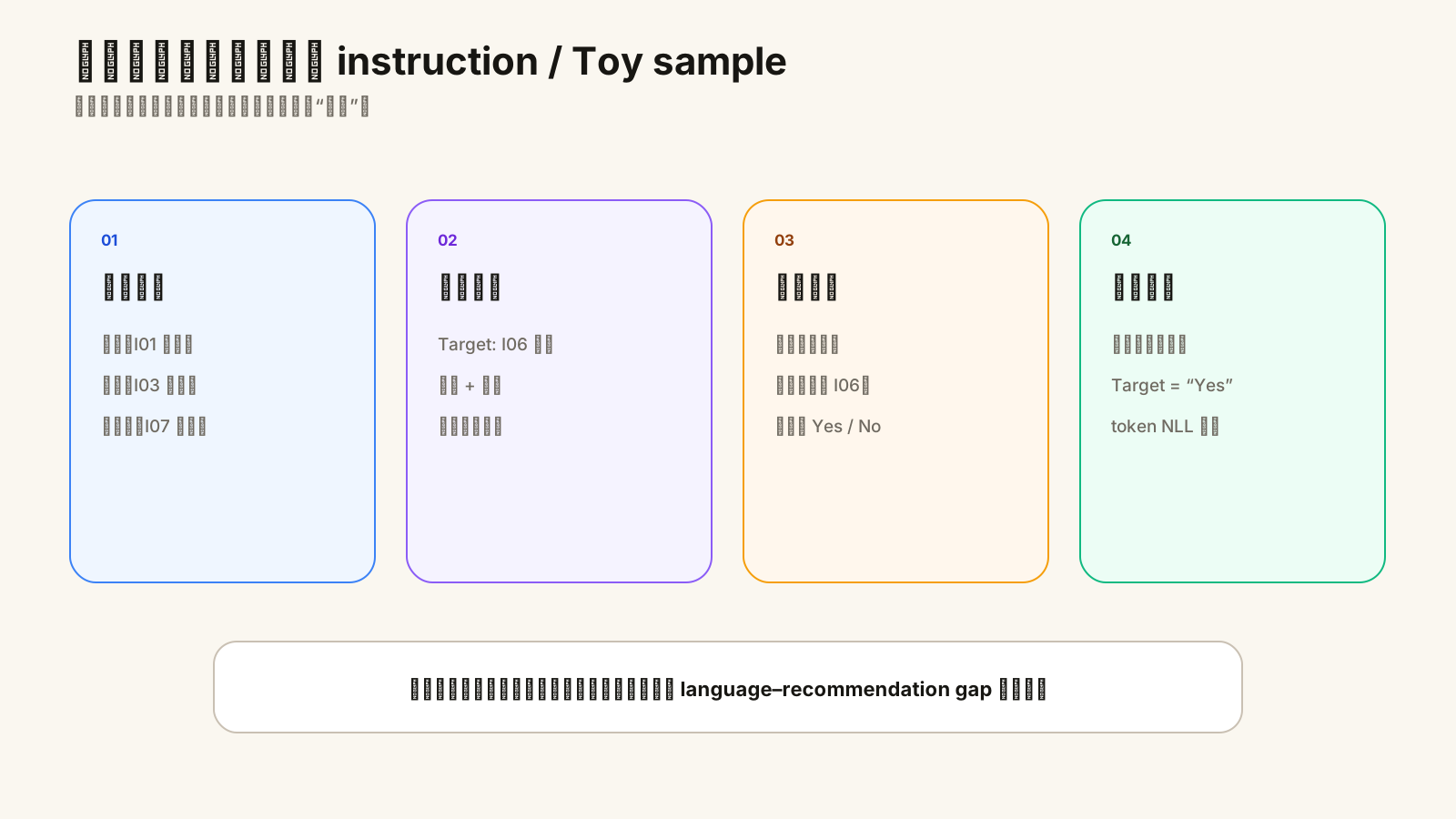
Figure 2. The answer comes from an observed rating or behavior label, not from the LLM’s own guess. Natural language carries the supervision.
All eight items remain in the catalog, but one example judges one target. This is pointwise preference prediction, not direct Top-K generation.
What happens from model input to output?
1. Alpaca tuning
LLaMA first trains on general self-instruct data, learning the relationship among instruction, input, and answer. This stage teaches task following rather than recommendation preference.
2. Rec-tuning
Recommendation samples then include:
- a task instruction;
- liked and disliked item descriptions;
- a target item description;
- and the expected
YesorNo.
3. LoRA in both stages
For a Transformer weight , LoRA freezes the full matrix and learns a low-rank update:
where rank . Only and are stored for the task.
The paper uses LLaMA-7B and reports training on one RTX 3090. “Efficient” here means parameter-efficient and feasible in memory; it does not mean a 7B forward pass is cheap to serve.
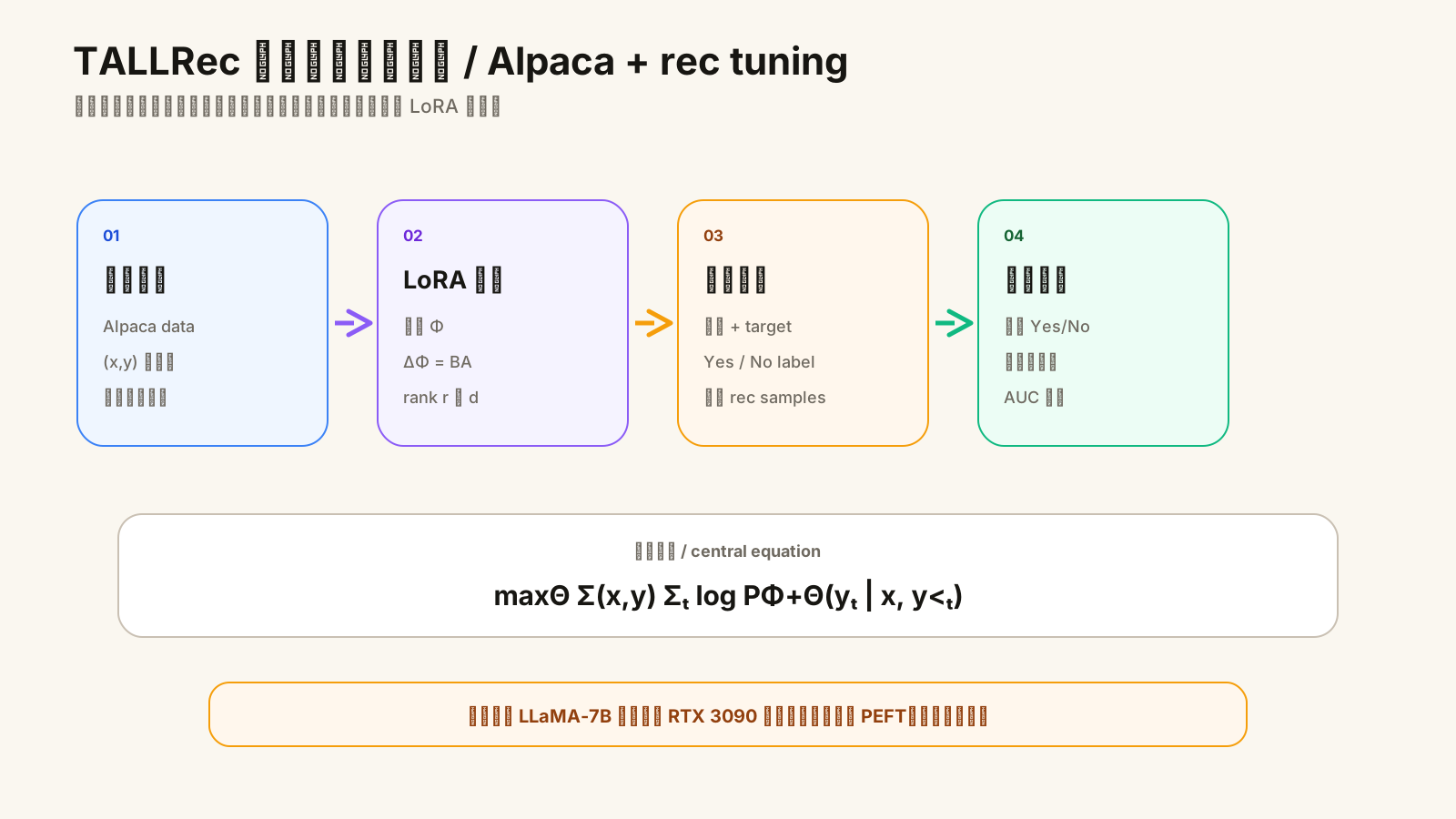
Figure 3. Stage one learns general instruction following; stage two learns the preference boundary. LoRA is the implementation mechanism, not the source of supervision.
Unpack the central equation
The rec-tuning objective is
- is the frozen LLaMA foundation;
- is the trainable LoRA update;
- is the recommendation instruction set;
- contains history, target, and task;
- is mainly
YesorNo; - is the adapted language model.
With a one-token answer, this is binary classification through the language-model head. At inference, Yes probability can act as a preference score and AUC asks whether positive targets outrank negative ones.
The equation is ordinary supervised fine-tuning. Its significance comes from , which places recommendation supervision in a form the model can consume, and , which prevents a tiny dataset from rewriting seven billion weights.
Training versus inference
# stage 1: general instruction alignment
freeze LLaMA weights Phi
train LoRA parameters on Alpaca instruction pairs

# stage 2: recommendation alignment
for each user-target example:
    split history into liked and disliked items
    insert titles and descriptions
    label the answer Yes or No
    update LoRA with causal language-model loss
Inference:
prompt = format(history, target_item)
logits = TALLRec(prompt)
score = P("Yes") / [P("Yes") + P("No")]
rank or classify the target by score
A careful implementation fixes answer words and tokenizer behavior:
Yesandyesmay be different tokens;- unrestricted generation may produce an explanation rather than one label;
- AUC should use scores, not hard 0/1 strings.
What do the experiments actually prove?
The paper uses Movie and Book domains with 16, 64, or 256 training examples. Table 3 reports AUC×100:
| Domain / shots | Best traditional or BERT-enhanced baseline | TALLRec |
|---|---|---|
| Movie / 16 | 50.85 | 67.24 |
| Movie / 64 | 51.71 | 67.48 |
| Movie / 256 | 54.20 | 71.98 |
| Book / 16 | 50.07 | 56.36 |
| Book / 64 | 50.06 | 60.39 |
| Book / 256 | 50.20 | 64.38 |
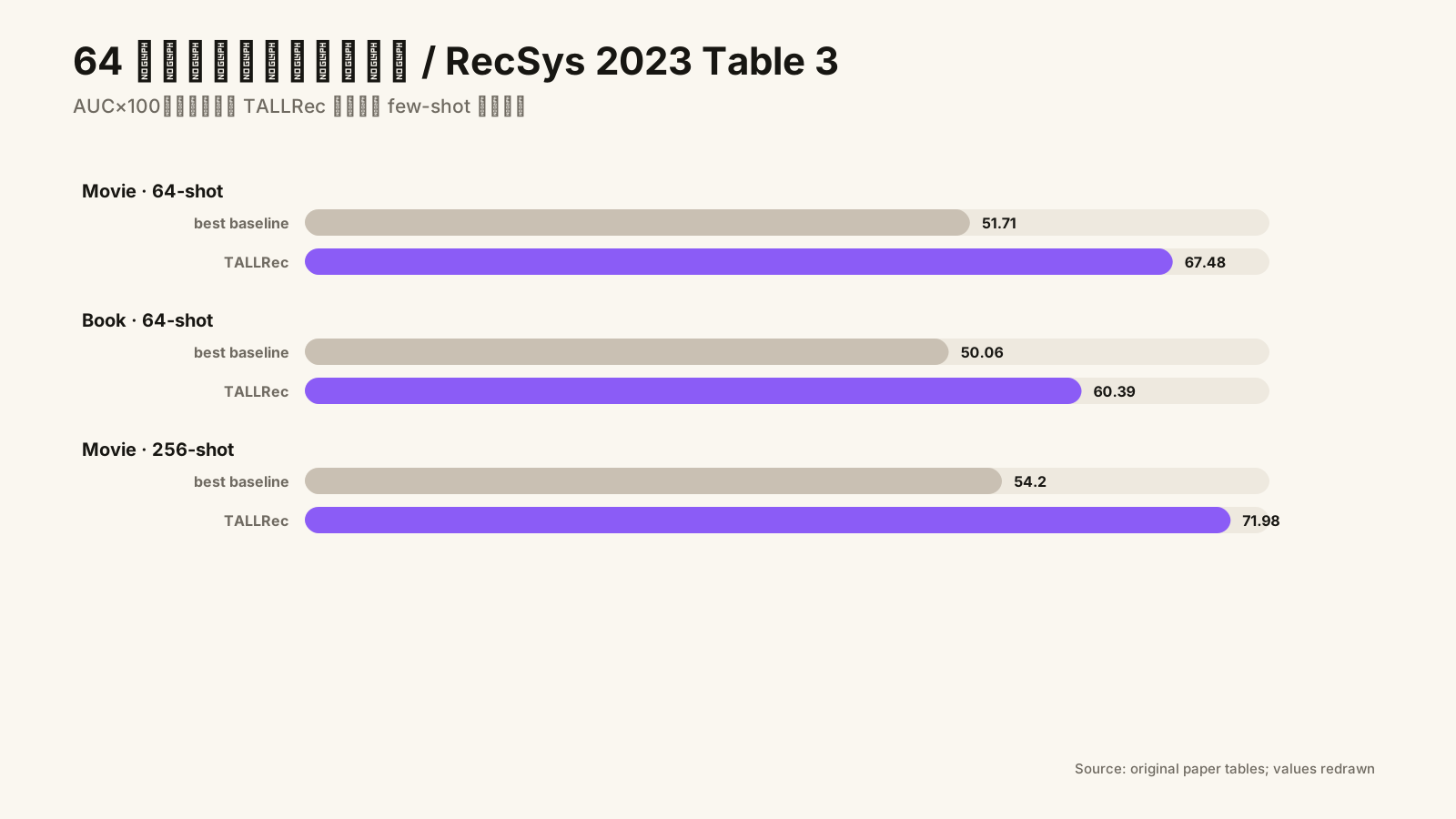
Figure 4. Values from Table 3. All methods receive the same few-shot training volume.
Two conclusions follow.
First, specialized sequence models learn almost no stable boundary from 16–256 examples; the pretrained LLM prior produces much higher sample efficiency.
Second, Figure 3 shows that direct in-context use of Alpaca-LoRA and GPT-family models stays close to random, while rec-tuning causes the jump. Knowledge stored in parameters is not yet task capability.
The ablation adds detail:
- Alpaca tuning alone is much weaker than rec-tuning;
- at no more than 128 rec examples, Alpaca plus rec-tuning generally beats rec-tuning alone;
- the gap narrows with more rec data, so general instruction priors matter most at the lowest-data regime;
- movie-tuned models transfer to books and vice versa, although in-domain or combined data is usually stronger.
Where does it fail?
1. The task is reduced to Yes/No
TALLRec judges one supplied target. It neither retrieves from a million items nor directly emits a legal Top-K list. Candidate generation remains external.
2. The experiment is small
Movie is a processed MovieLens-100K subset with 10,000 recent interactions. Book histories are randomly sampled because timestamps are unavailable. Two domains and a few hundred examples do not represent ads, short video, or e-commerce funnels.
3. Text may create popularity shortcuts
Titles and descriptions provide semantics, but the model may learn general attractiveness rather than personal collaborative preference. The paper does not fully isolate the two with counterfactual controls.
4. LoRA reduces training cost, not forward cost
Updating a tiny fraction of parameters still executes the LLaMA-7B body. High-QPS ranking needs quantization, distillation, caching, or a smaller model.
5. History is capped at ten items
The main experiment never confronts hundreds of cross-topic events, interest drift, repetition, and noise.
6. AUC is not list quality
The binary target does not measure diversity, novelty, calibration, exposure bias, or online value.
Why does the next paper need to exist?
TALLRec proves that a small amount of rec-tuning crosses the domain gap. The obvious next move is to put more history in the prompt. Should performance keep improving?
Surprisingly, no. Long before the context window is full, AUC peaks and falls. The history fits, but the model cannot extract the right evidence.
ReLLa, the next paper, names this lifelong sequential behavior incomprehension and addresses it with target-conditioned behavior retrieval (SUBR) and retrieval-enhanced tuning (ReiT). In a long-context world, selection can matter more than capacity.
Paper: Bao et al., “TALLRec: An Effective and Efficient Tuning Framework to Align Large Language Model with Recommendation,” RecSys 2023.
Primary source: arXiv:2305.00447
Series: Twenty Papers to Understand the Past and Present of Generative Recommendation