“One model for every recommendation task” sounds elegant until the model enters a real app.
Retrieval searches millions of items. CTR ranking has a millisecond budget. Explanation and dialogue generate text. An on-device ranker may have only a few megabytes. A model that wins offline but is too slow—or must be copied once per task—is not an industrial foundation.
P5, the previous paper, shows that five recommendation families can share a text-to-text interface. M6-Rec: Generative Pretrained Language Models are Open-Ended Recommender Systems asks the production version:
Can a shared model cover retrieval, ranking, explanation, dialogue, and content creation while running both in the cloud and on phones?
M6-Rec is not one isolated algorithm. It is a system of foundation, task formulations, efficient adaptation, and serving optimizations. It puts the foundation-model idea inside a recommender’s latency budget.
Understand the paper in 30 seconds
- P5’s limitation: tasks share an interface, but full-catalog retrieval, real-time ranking, and edge deployment remain unresolved.
- M6-Rec’s answer: textualize behavior and item information on a shared M6 foundation; use contrastive vectors for retrieval, language understanding for ranking, generation for open tasks, and option-adapter tuning, late interaction, distillation, pruning, and early exits to reduce task parameters and latency.
- The decisive evidence: on TaoProduct CTR, AUC rises from DIN’s 0.7611 to 0.7995; MiniApp retrieval HR@100 rises from TwinBERT’s 69.6% to 74.1%; replacing the online retrieval model yields over 1.0% relative CTR improvement.
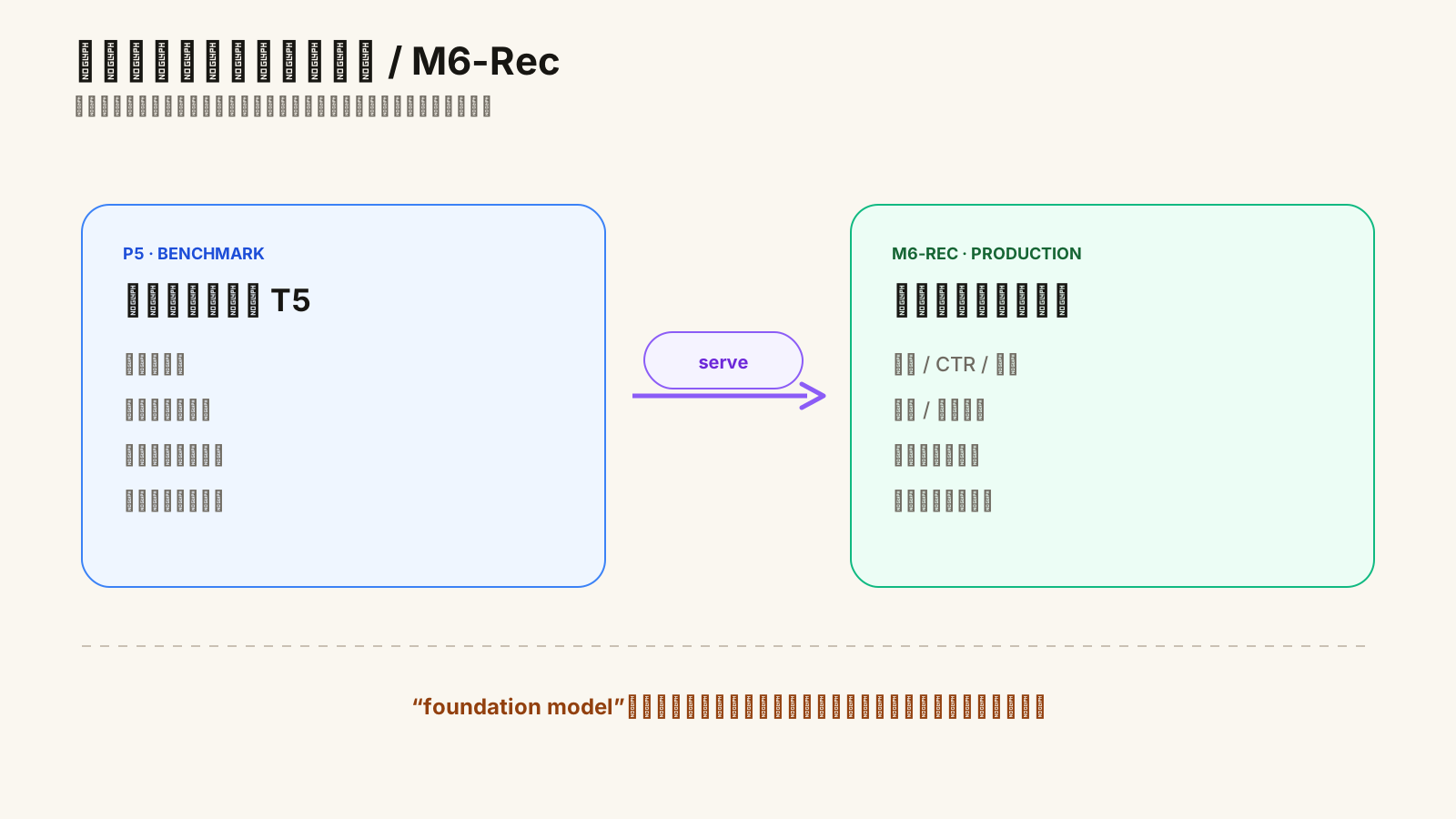
Figure 1. An industrial foundation model is judged jointly by task coverage, sample efficiency, latency, size, and deployment location.
What problem did the previous paper leave behind?
P5 unifies tasks on one encoder–decoder, but production stages have different computational contracts:
| Stage | Typical output | Binding constraint |
|---|---|---|
| retrieval | vector / candidate set | billion-scale index |
| CTR ranking | click probability | latency and throughput |
| explanation | text | readability and faithfulness |
| dialogue | response and items | coherence and control |
| creation | query, title, or prompt | diversity and quality |
Forcing every stage through autoregressive beam search would make retrieval unusable. Fully fine-tuning one foundation copy per task would make storage and operations explode.
M6-Rec follows a pragmatic principle:
Share pretrained knowledge and most parameters; do not require every task to use the identical output head or serving path.
Understand open-ended tasks with eight items
Reuse Lin’s behavior:
I01 racket → I03 climbing shoes → I05 shuttlecock → I06 goggles
M6-Rec represents it as ordinary text, roughly:
A young male user recently clicked a racket, climbing shoes,
and a shuttlecock...
The paper deliberately avoids relying on Item IDs, emphasizing titles, categories, and descriptions. A new query or product can then be encoded without a training-time ID embedding.
One user description enters several execution paths:
- Retrieval: encode user text as , item text as , and perform kNN search.
- Ranking: combine history with candidate
I06 gogglesand predict click versus no click. - Explanation: generate a personalized reason.
- Creation: generate a likely search query or product title from behavior.
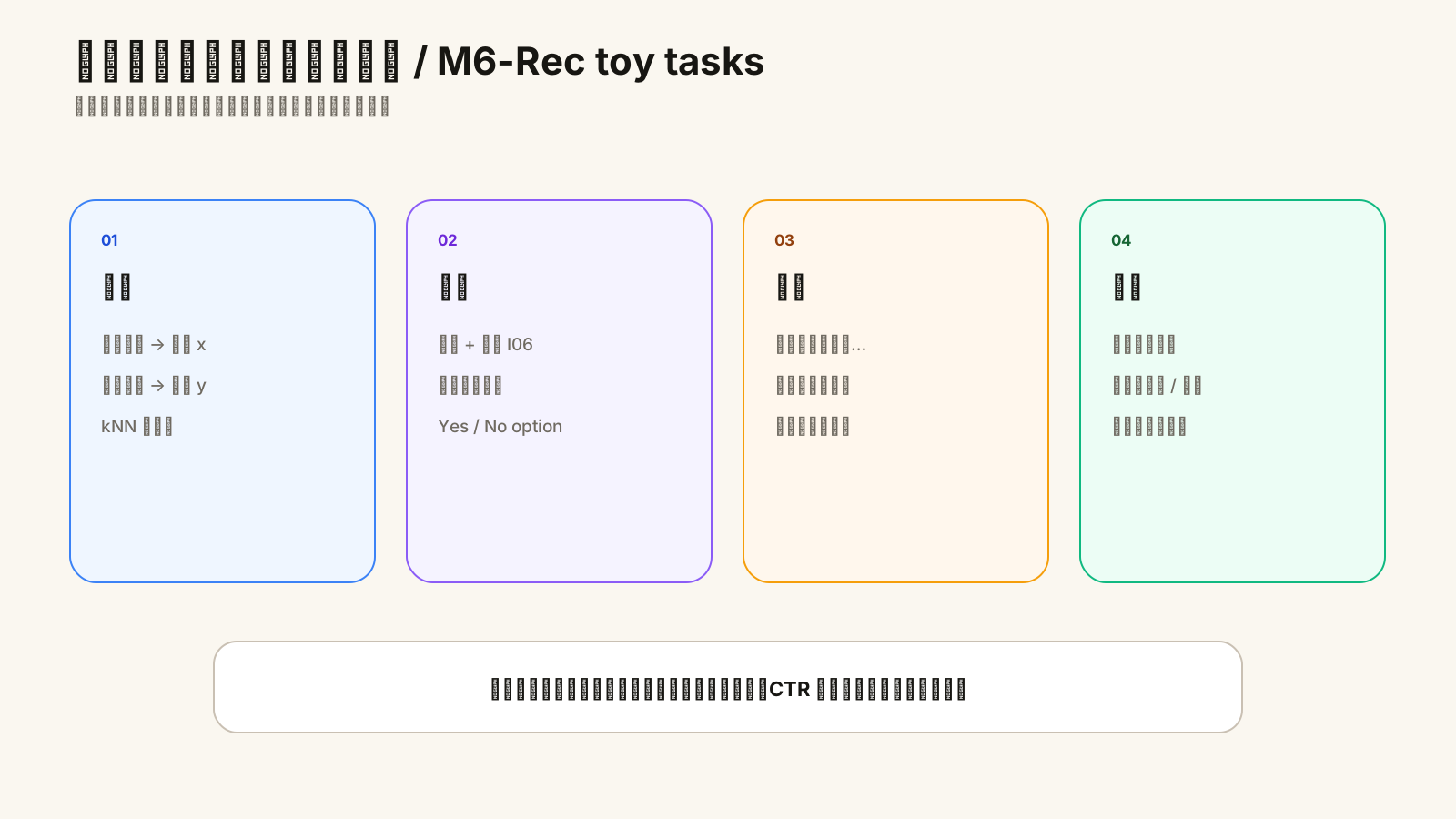
Figure 2. A shared foundation does not imply an identical head. Retrieval needs indexable vectors, ranking needs probabilities, and open tasks need token sequences.
The choice has a cost. Text generalizes to unseen products, but it can miss anonymous collaborative structure: semantically dissimilar products may be bought by the same group. LLaRA will later reintroduce that signal explicitly.
What happens from model input to output?
1. Reuse a pretrained foundation
M6 is an industrial pretrained language model with text-infilling and autoregressive objectives. M6-Rec does not train a recommendation language model from scratch. It reformats recommender data as text and adapts the foundation.
2. Retrieval: dual vectors and contrastive learning
User and item text pass through the Transformer separately. Selected states are projected to 128 dimensions and $L_2$-normalized:
Item vectors can be precomputed and placed in a nearest-neighbor index. Retrieval therefore does not autoregressively decode every catalog item.
3. Ranking: multi-segment late interaction
Running the full foundation once per candidate is too slow. M6-Rec divides a request into reusable segments:
profile | click I01 | click I03 | click I05 | candidate I06
The first layers encode and cache each segment independently. At request time, cached states are concatenated and only the final layers perform cross-segment interaction. One reported setting precomputes 21 layers and runs the final three online.
Fine segmentation matters: one new click requires one new segment, while old behavior and candidate representations remain reusable.
4. Adaptation: option tuning plus adapters
Prompt tuning prepends trainable soft prompts but usually learns a separate classifier. M6-Rec reuses the final prompt embeddings as class options—for example, click and no click.
Low-rank FFN adapters are added as well, making roughly 1% of parameters task-specific. In Table 8, option-adapter tuning slightly exceeds full fine-tuning on all three reported CLUE tasks.
5. Compression: M6-Edge
The paper distills a roughly 300M M6-base model into a 10M M6-Edge, then combines parameter sharing and pruning for a 2M variant. Intermediate-layer losses also enable early exit under device constraints.
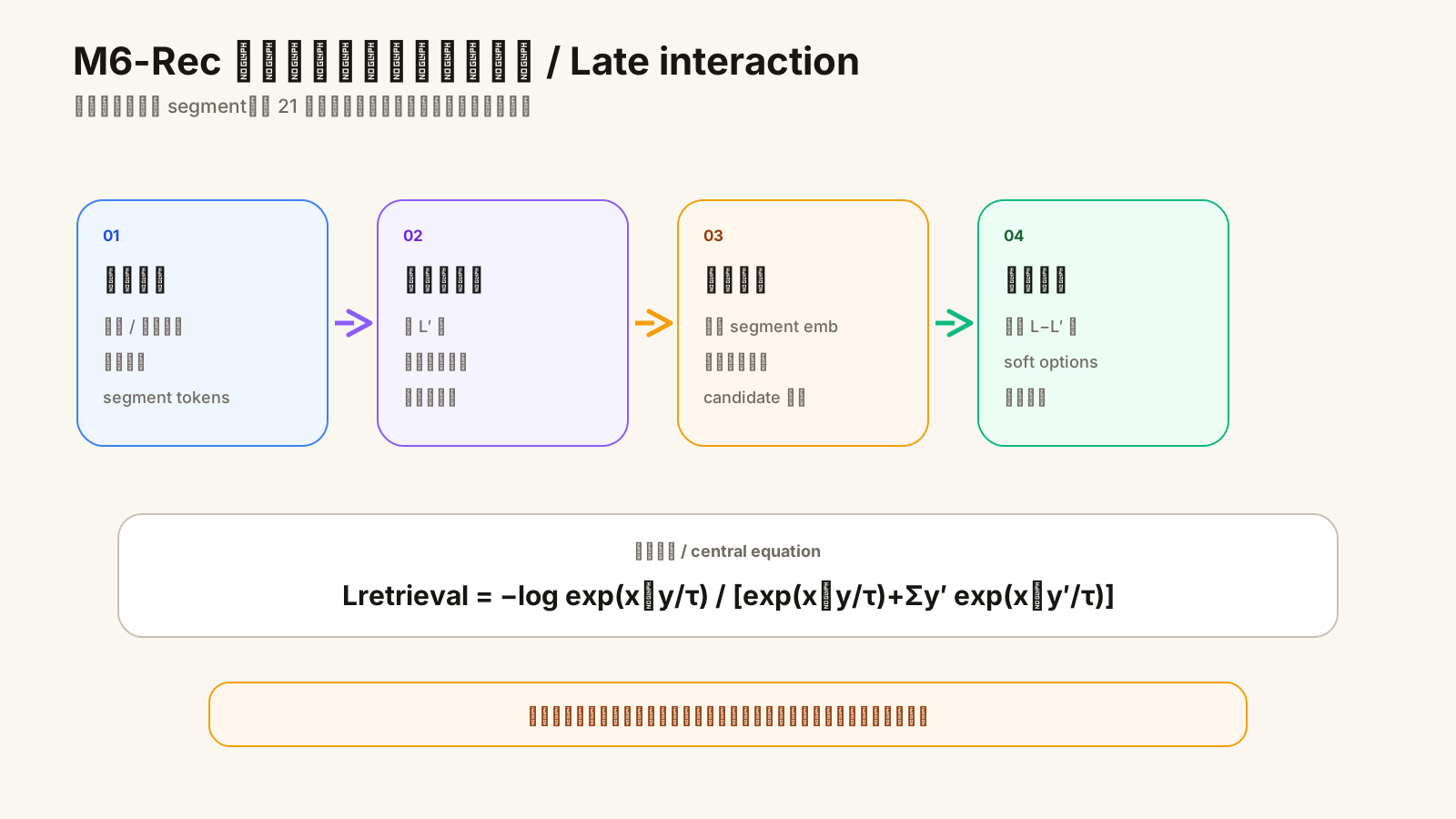
Figure 3. Most deep computation is moved into reusable caches; only shallow interaction stays online. The optimization relocates interaction rather than simply deleting it.
Unpack the central equation
Retrieval uses a temperature-scaled contrastive loss:
- is an observed user–item click;
- is similarity after normalization;
- contains sampled negatives, commonly other batch items;
- is the reported temperature.
For Lin, represents the text describing racket, climbing-shoe, and shuttlecock clicks. Positive describes goggles; negatives may describe a yoga mat or protein bar.
The equation makes an important point: M6-Rec does not turn retrieval into token-by-token generation. It turns a language model into a semantic encoder and preserves an ANN-compatible retrieval architecture.
Training versus inference
Retrieval training
user_vec = normalize(project(M6(user_text)))
item_vec = normalize(project(M6(item_text)))
negatives = other items in the mini-batch
loss = contrastive_softmax(user_vec, item_vec, negatives, tau=0.07)
Retrieval serving
offline:
    encode every item and build an ANN index
online:
    encode the current user
    retrieve nearest item vectors
CTR ranking
offline/cache:
    encode each stable segment through layers 1...L'
online:
    combine cached profile, history, and candidate segments
    run layers L'+1...L
    score the click option
Open generation
format behavior as text
adapt the shared foundation on generation examples
decode an explanation, response, query, or title
M6-Rec is therefore several execution plans on one foundation, not one function replacing the entire funnel.
What do the experiments actually prove?
Offline effectiveness:
- TaoProduct CTR: DIN 0.7611, M6-Rec 0.7995;
- AlipayQuery CTR: DIN 0.7332, M6-Rec 0.7508;
- AlipayMiniApp HR@100: TwinBERT 69.6%, M6-Rec 74.1%;
- unseen-item subset: TwinBERT 49.6%, M6-Rec 57.0%, while ID-based YouTubeDNN fails;
- explanation BLEU-4: PETER+ 3.06, M6-Rec 3.59.
Serving tradeoff:
- full 24-layer M6-Rec: AUC 0.7995 at 57 ms;
- distilled 3-layer model: AUC 0.7566 at 16 ms;
- late interaction with three online layers: AUC 0.7731 at 16 ms.
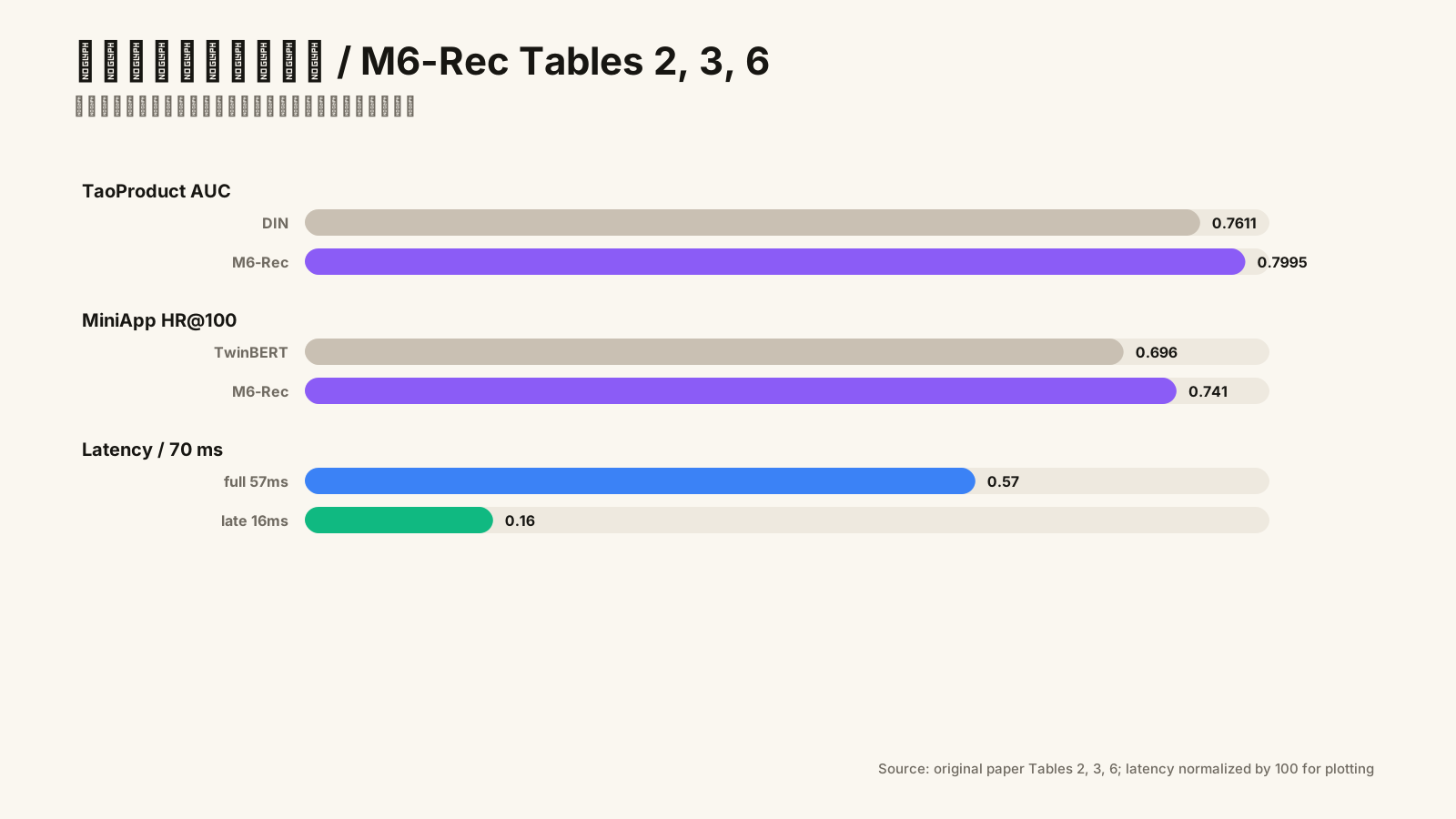
Figure 4. Values from Tables 2, 3, and 6. Latency is divided by 100 only for plotting; labels preserve the reported milliseconds.
At the same reported latency as the three-layer student, late interaction retains more AUC, supporting cached deep representations over uniformly shrinking the model. It still loses 0.0264 AUC against the full model, so acceleration is not free.
The paper also reports production evidence:
- replacing a TwinBERT-like MiniApp retriever produced over 1.0% relative CTR improvement and was fully deployed in July 2021;
- an M6-Edge phone ranker increased clicks by about 0.4%.
These are author-reported online results, not independently reproduced experiments; traffic allocation, duration, and confidence intervals are not fully published.
Where does it fail?
1. “Open-ended” is coverage, not an unlimited guarantee
Each task still needs a schema, prompt, head, or adaptation data. A novel business task with no output protocol does not become operational automatically.
2. Removing IDs helps cold start but weakens collaborative identity
Textual similarity is not purchase similarity. Similar products may target different price segments, while dissimilar products may have strong co-consumption.
3. Late interaction creates a cache system
Invalidation, segment versioning, privacy, memory, and fast-changing candidates add engineering cost. Model latency is not end-to-end service latency.
4. Specialized components remain
Retrieval uses projections and ANN, classification uses soft options, and generation uses decoding. M6-Rec unifies the foundation, not the entire funnel.
5. Generation metrics do not establish faithfulness
BLEU, ROUGE, and diversity do not prove that an explanation reflects the ranking decision or that generated product content is safe and usable.
6. Full reproduction is difficult
Core datasets and systems come from Alipay and Taobao. An external lab cannot recreate the pretraining corpus, online environment, and deployment stack exactly.
Why does the next paper need to exist?
P5 and M6-Rec rely on an optimistic premise: a language model already contains rich knowledge, so the right textual formulation should transfer that ability into recommendation.
What happens if a general LLM receives a history and target item directly?
TALLRec, the next paper, gives an unromantic result: zero-shot LLM recommendation AUC can sit near random guessing. Language understanding and preference prediction are separated by a domain gap. A small amount of recommendation instruction tuning—not cleverer wording—is what crosses it.
Paper: Cui et al., “M6-Rec: Generative Pretrained Language Models are Open-Ended Recommender Systems,” 2022.
Primary source: arXiv:2205.08084
Series: Twenty Papers to Understand the Past and Present of Generative Recommendation