<a_234><b_1262><c_941> is a product address to a generative recommender and three new symbols to a general LLM.
If we simply ask:
analyze the user's interests, then recommend the next itemic token
the model may write fluent analysis without knowing what the codes mean. Worse, the analysis may be a story added after the answer while hidden pattern matching performs the prediction.
MTGR combines engineered signals and a scalable backbone, but its decision remains implicit. OneRec-Think: In-Text Reasoning for Generative Recommendation systematically inserts textual reasoning into industrial generative recommendation:
[ \text{history}\rightarrow\text{text CoT}\rightarrow\text{item tokens}. ]
The paper in 30 seconds
- The previous limitation: OneRec generates valuable sessions but remains a black-box predictor. Itemic tokens are not grounded in language, so instruction following and explicit reasoning are difficult to activate.
- OneRec-Think's answer: four-task Itemic Alignment; rationale distillation from pruned histories followed by SFT on raw noisy histories; Rollout-Beam reward and GRPO; then offline reasoning plus two code prefixes with online OneRec finalization.
- The evidence: on Beauty, NDCG@10 rises from 0.0377 for Base to 0.0402 with Itemic Alignment and 0.0471 with reasoning. Online, Kuaishou reports +0.159% app stay time and +0.169% watch time.
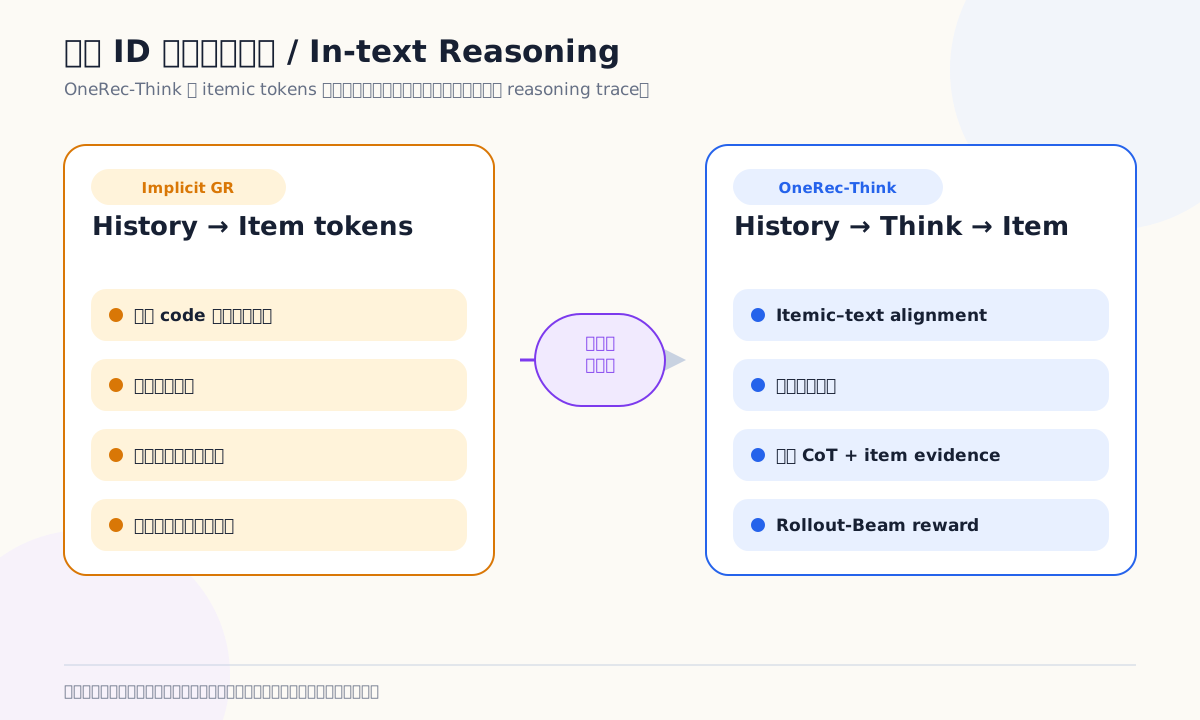
Figure 1. Text creates an explanation and instruction interface. Merely producing a CoT is not sufficient evidence that the intermediate reasoning caused the answer.
A current constraint in the eight-item example
The user has mixed history:
tennis racket → climbing shoes → badminton racket → swim cap
and now says:
"My shoulder hurts; I want something for gentle recovery."
Behavioral transition alone may continue with rackets or climbing. A language model should treat injury, gentleness, and recovery as strong current constraints:
<think>
The user has several long-term sports interests but recently moved toward swimming.
Current shoulder discomfort lowers the priority of high-impact equipment.
A quick-dry towel fits a lighter recovery context.
</think>
<item_begin><a_...><b_...><c_...><item_end>
OneRec-Think factorizes:
[ \tau\sim P(\cdot\mid \mathcal P(S_u);\theta), \qquad s_{v_{n+1}}\sim P(\cdot\mid\mathcal P(S_u),\tau;\theta), ]
where (\tau) is the reasoning sequence and (s_{v_{n+1}}) is the target itemic pattern.
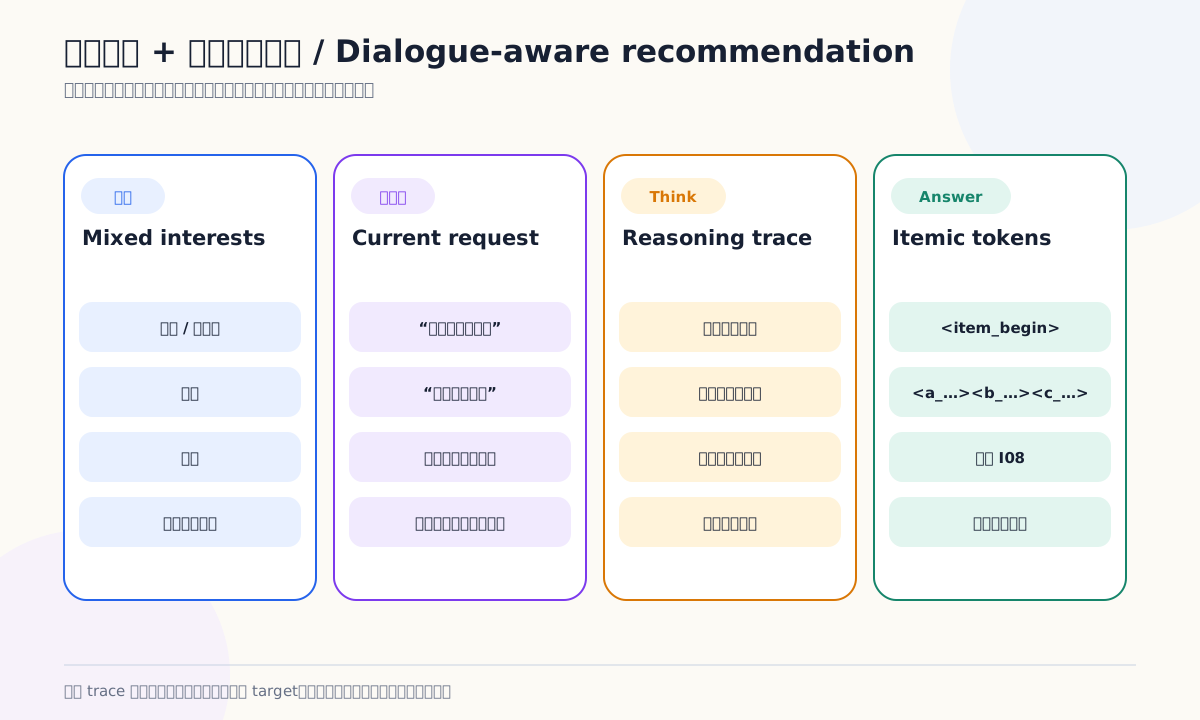
Figure 2. An ideal trace extracts evidence from history and the current instruction without revealing the target inside the reasoning.
Stage one: give itemic tokens meaning
Itemic Alignment uses four next-token tasks.
Interleaved User Persona Grounding
Static attributes, search behavior, interaction tokens, and natural-language interest summaries are interleaved so both modalities share context.
Sequential Preference Modeling
History-to-next-item prediction preserves collaborative and temporal behavior.
Itemic Dense Captioning
Generate a detailed description from item tokens. The pattern must recover content rather than merely index an ID.
General Language Modeling
Continue training on ordinary text so the base model does not lose general language ability.
Training has two substages:
Token Warm-up:
  freeze the base LLM; train only new item embeddings

Multi-Task Integration:
  unfreeze all parameters; mix the four task families
The industrial model starts from Qwen-8B and adds 24,576 tokens: 8,192 codes at each of three levels, plus boundary markers. A daily incremental pipeline uses 80 flagship GPUs and processes roughly 20B tokens.
Stage two: learn reasoning from easier histories
Real histories are long and noisy. Asking a teacher to reason directly over thousands of events often yields a summary rather than a useful bridge. The paper creates an easier curriculum:
- take the known target item;
- retrieve the top-(k) history items most similar to it;
- ask the aligned teacher to explain why that pruned history leads to the target;
- use the rationale as supervision while training the student on the full raw history.
The loss covers reasoning and answer tokens:
[ \mathcal L_{\rm RA} =-\sum_{i=1}^{M}\log P(r_i\mid H,r_{<i}) -\sum_{j=1}^{L}\log P(s_j^\mid H,\tau,s_{<j}^). ]
The teacher constructs a bridge in a low-noise context; the student learns to recover it from noise.
The supervision deserves scrutiny. The teacher sees the target and the pruning step uses target similarity. The student does not receive the target at inference and may learn real denoising, but the rationale contains hindsight bias: it explains a known answer rather than genuinely exploring unknown futures.
Stage three: rewarding multiple plausible answers
Exact-match reward is extremely sparse. In a huge catalog, nearly every CoT rollout misses the one logged target, leaving every GRPO sample at zero.
After generating a reasoning path, OneRec-Think beam-searches width (K) over item codes and rewards the best candidate's component matches:
[ R_{\text{Rollout-Beam}} =\max_{\hat s\in B_K} \sum_{l=1}^{L}\mathbf 1[\hat s_l=s_l^*]. ]
The signal is denser because:
- an early-code match indicates the right coarse semantic direction;
- any beam candidate can credit the reasoning path;
- training reward resembles beam-search inference.
The implementation samples 16 CoT paths per prompt, uses beam width 32, and performs GRPO for two epochs.
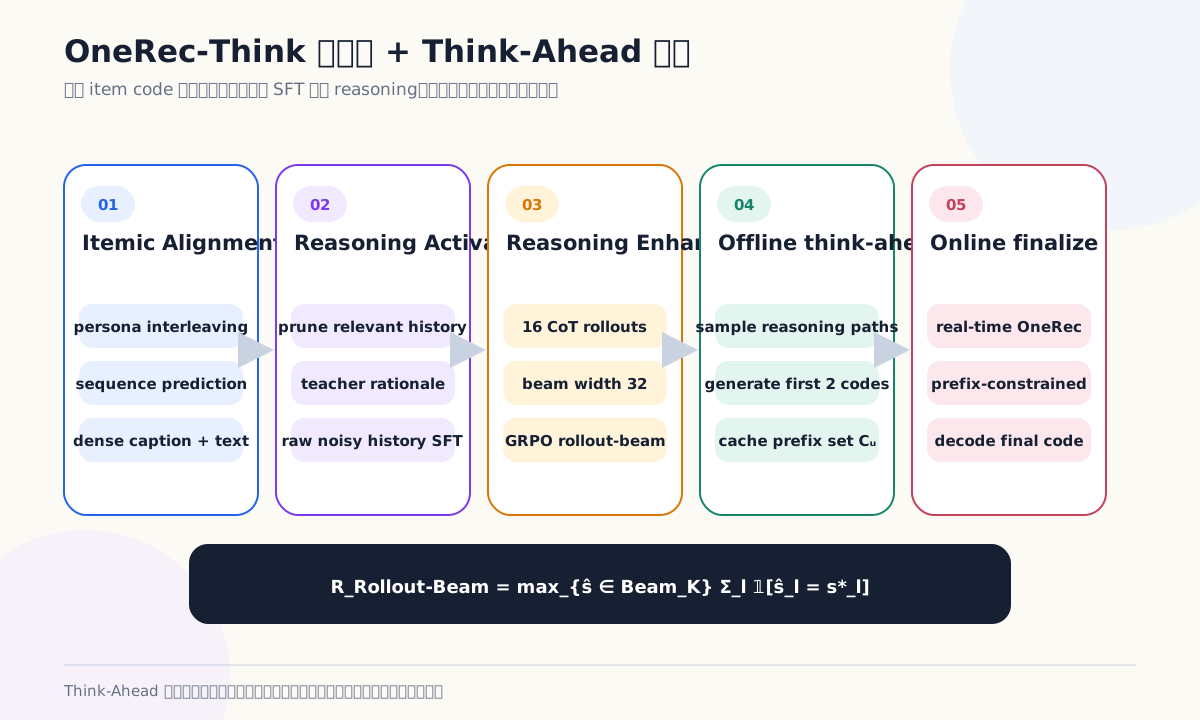
Figure 3. Alignment makes codes readable, SFT establishes a reasoning format, and RL tries to make the format lead to retrievable answers.
How Think-Ahead serves slow reasoning
An 8B model cannot generate a long CoT and run beam search on every online request. Think-Ahead separates:
Offline
Sample (T) reasoning paths per user. Each path generates the first two code levels and retains (m) beam prefixes. Their union is cached:
[ C_u=\bigcup_{i=1}^{T}A_u^{(i)}. ]
The slow model's possible interest directions become materialized candidate prefixes.
Online
A frequently updated OneRec reads fresh behavior and finishes the last code only under prefixes in (C_u):
[ \hat s =\arg\max_s P_{\rm online}(s\mid H_u), \quad \text{s.t. }(\hat s_1,\hat s_2)\in C_u. ]
This combines an offline semantic prior with online behavioral freshness. The production path does not generate the full textual CoT or read it token by token; reasoning is compressed into prefix constraints.
What the experiments establish
Public Amazon results include:
| Dataset | Metric | HSTU | ReaRec | OneRec-Think |
|---|---|---|---|---|
| Beauty | Recall@10 | 0.0652 | 0.0704 | 0.0791 |
| Beauty | NDCG@10 | 0.0353 | 0.0344 | 0.0471 |
| Sports | Recall@10 | 0.0343 | 0.0332 | 0.0412 |
| Toys | Recall@10 | 0.0566 | 0.0764 | 0.0797 |
The Beauty stage ablation is:
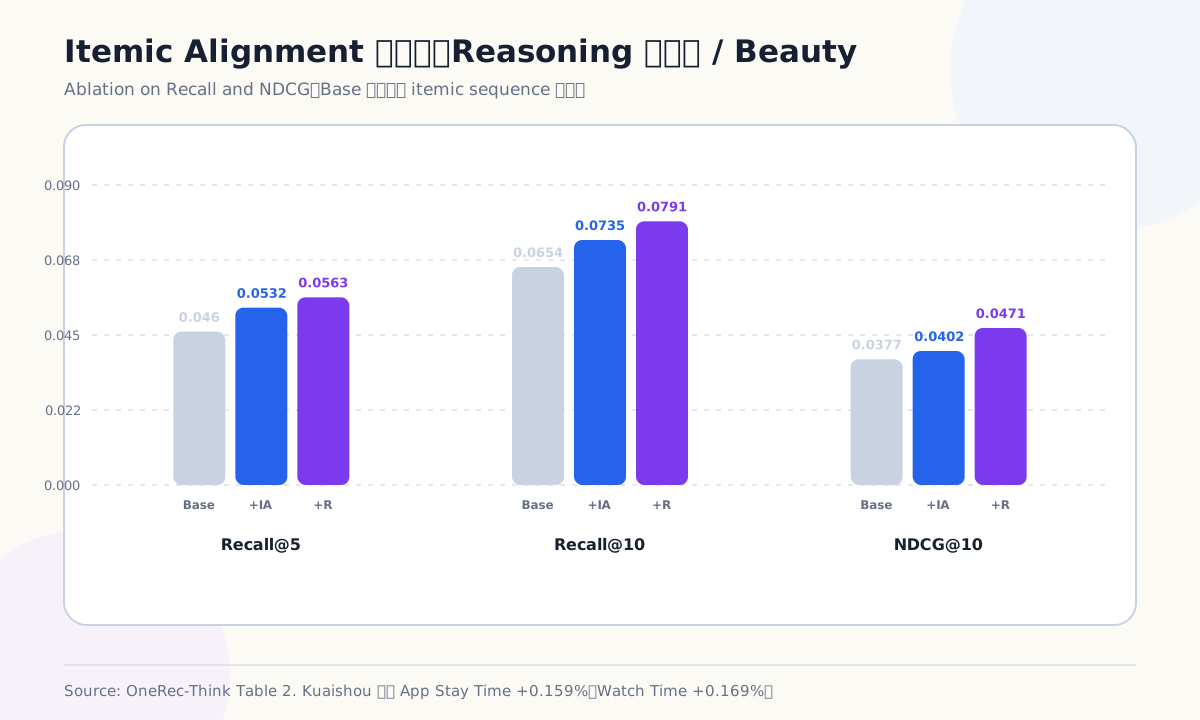
Figure 4. Alignment adds one layer of gain and reasoning adds another. This supports the combined recipe but does not isolate better supervision from extra test-time tokens.
| Training | Recall@5 | Recall@10 | NDCG@10 |
|---|---|---|---|
| Base | 0.0460 | 0.0654 | 0.0377 |
| Base + IA | 0.0532 | 0.0735 | 0.0402 |
| Base + IA + Reasoning | 0.0563 | 0.0791 | 0.0471 |
On an industrial short-video understanding benchmark, BERTScore rises from Qwen3's 0.6031 to 0.6443 after token warm-up and 0.7300 after multitask integration.
A one-week online test on 1.29% traffic reports:
| Metric | Relative change |
|---|---|
| App stay time | +0.159% |
| Watch time | +0.169% |
| Video views | +0.150% |
| Follows | +0.431% |
| Forwards | +0.758% |
At a strong industrial baseline, tenths of a percent can matter. The experiment validates the complete system, not the faithfulness of visible CoT by itself.
Where OneRec-Think breaks
Reward checks the answer, not the rationale
Rollout-Beam reward does not verify factual accuracy, historical grounding, or contradictions in the explanation. Nonsensical reasoning that leads to the right prefix still wins.
Teacher rationales have hindsight bias
The teacher sees the target and retrieves target-related history. This creates useful explanations but can teach rationalization rather than genuine search among possible futures.
Multi-validity remains bounded by logs
Beam and partial-code credit densify reward, yet positives still come from one realized interaction. Good unexposed alternatives have no label.
Online serving does not literally think token by token
Think-Ahead compresses CoT into cached two-level prefixes. Online gain can come from a stronger offline retrieval prior rather than real-time textual reasoning.
Readability is not faithfulness
A model can produce a plausible preference narrative while its decision follows a hidden shortcut. The paper presents cases and accuracy but no causal intervention such as editing one reasoning premise and measuring answer changes.
Why OneReason comes next
OneRec-Think supplies a complete think-then-recommend system. The team later observes an uncomfortable result:
On broader recommendation benchmarks, thinking mode does not consistently beat non-thinking mode.
Longer CoT is not the missing ingredient. Two foundational abilities may be absent:
- Perception: does the model truly ground itemic tokens in content?
- Cognition: does the CoT compress history into latent interests and model their evolution rather than paraphrasing?
OneReason, the final chapter, starts from that failure. It defines R0–R3 reasoning, four-granularity pretraining, structured CoT, and specialize-then-unify RL—and reports a rare counterexample: thinking is worse after SFT and becomes consistently better only after targeted RL.
Critical takeaway: OneRec-Think gives recommendation a unified interface from language constraints through explicit reasoning to item addresses, while taking production latency seriously. Its limitation is equally important: answer accuracy shows that CoT can be useful; it does not show that CoT is faithful. Serious recommendation reasoning begins with that distinction.