The word “goggles” tells an LLM that the item belongs to swimming, may be anti-fog, and often appears with a swim cap.
The embedding of item_06 inside SASRec tells a different story: which anonymous users click it, which IDs precede it, and which products share a behavioral neighborhood.
The two kinds of knowledge are complementary but occupy different coordinate systems:
language space: titles, descriptions, commonsense
recommender space: IDs, co-occurrence, transitions
ReLLa, the previous paper, uses semantic vectors to retrieve relevant behavior, but the LLM still receives mainly product text. LLaRA: Large Language-Recommendation Assistant proposes a more direct fusion:
Treat the Item ID embedding learned by a conventional recommender as a behavioral modality, project it to the LLM dimension, and place it beside the product title as an extra token.
The LLM does not replace SASRec. SASRec becomes one of its perceptual organs.
Understand the paper in 30 seconds
- ReLLa’s limitation: text semantics can select relevant behavior but cannot fully represent anonymous co-occurrence and sequential patterns learned by a recommender.
- LLaRA’s answer: represent every item with both textual tokens and a projected behavioral token. Begin with a text-only prompt and increase the probability of hybrid prompts as , allowing the LLM to adapt to a new modality.
- The decisive evidence: LLaRA reaches HitRatio@1 of 0.4737, 0.4949, and 0.4508 on MovieLens, Steam, and LastFM, above TALLRec’s 0.3895, 0.4637, and 0.4180. Vanilla Llama2’s valid-answer ratio falls as low as 16.53%; every LLaRA variant exceeds 95%.
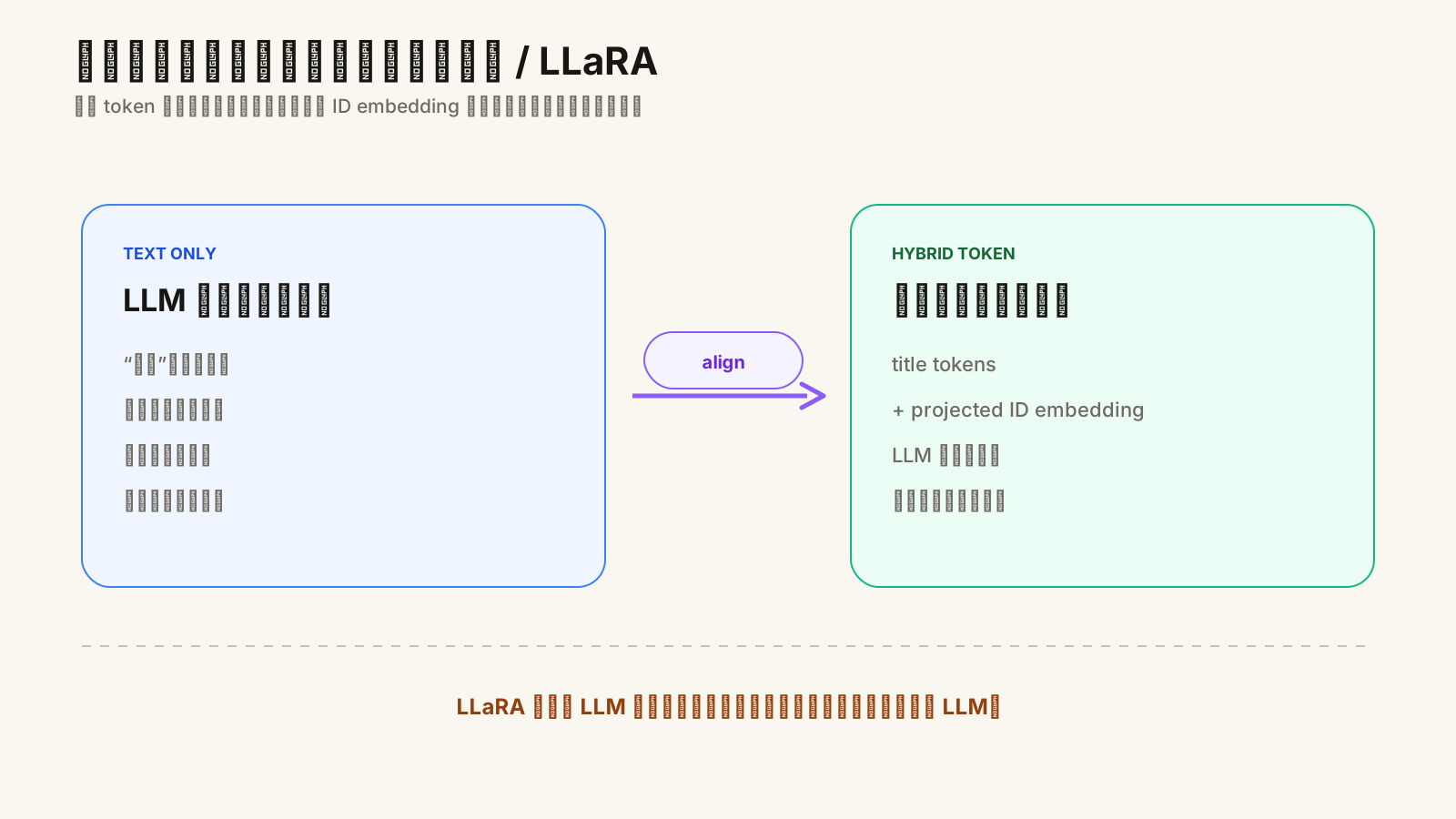
Figure 1. Hybrid representation does not choose between text and IDs. It lets both token streams enter the LLM.
What problem did the previous paper leave behind?
LLM-based recommendation commonly chooses one of two item forms.
Item IDs only
The user interacted with item_17, item_42, item_9...
IDs map exactly to logs, but the pretrained LLM does not know what they denote. Numeric tokenization can even create meaningless surface similarity.
Item text only
The user watched Titanic, Roman Holiday...
Text invokes world knowledge and describes cold items, but it does not preserve the full collaborative structure of who consumed what.
Semantically similar films can attract different audiences. Semantically different products can be consecutive steps in one task. Traditional recommenders learn these distributions from anonymous behavior.
LLaRA’s central assumption is:
Sequential behavior is not just another text field. It is a separate modality that needs an interface before fusion.
Understand a hybrid token with eight items
Take I06 goggles.
Textual tokens
The LLM tokenizer processes the title:
Several token embeddings may encode language priors about swimming and eye protection.
Behavioral token
First train GRU4Rec, Caser, or SASRec and read its item embedding:
This is not yet an LLM token. LLaRA applies a two-layer SR2LLM projector:
Its output has the LLM hidden dimension and can enter the token sequence.
Hybrid representation
A toy prompt becomes:
History:
racket <behavior_I01>,
climbing shoes <behavior_I03>,
shuttlecock <behavior_I05>

Candidates:
goggles <behavior_I06>,
yoga mat <behavior_I07>, ...

Output exactly one candidate title.
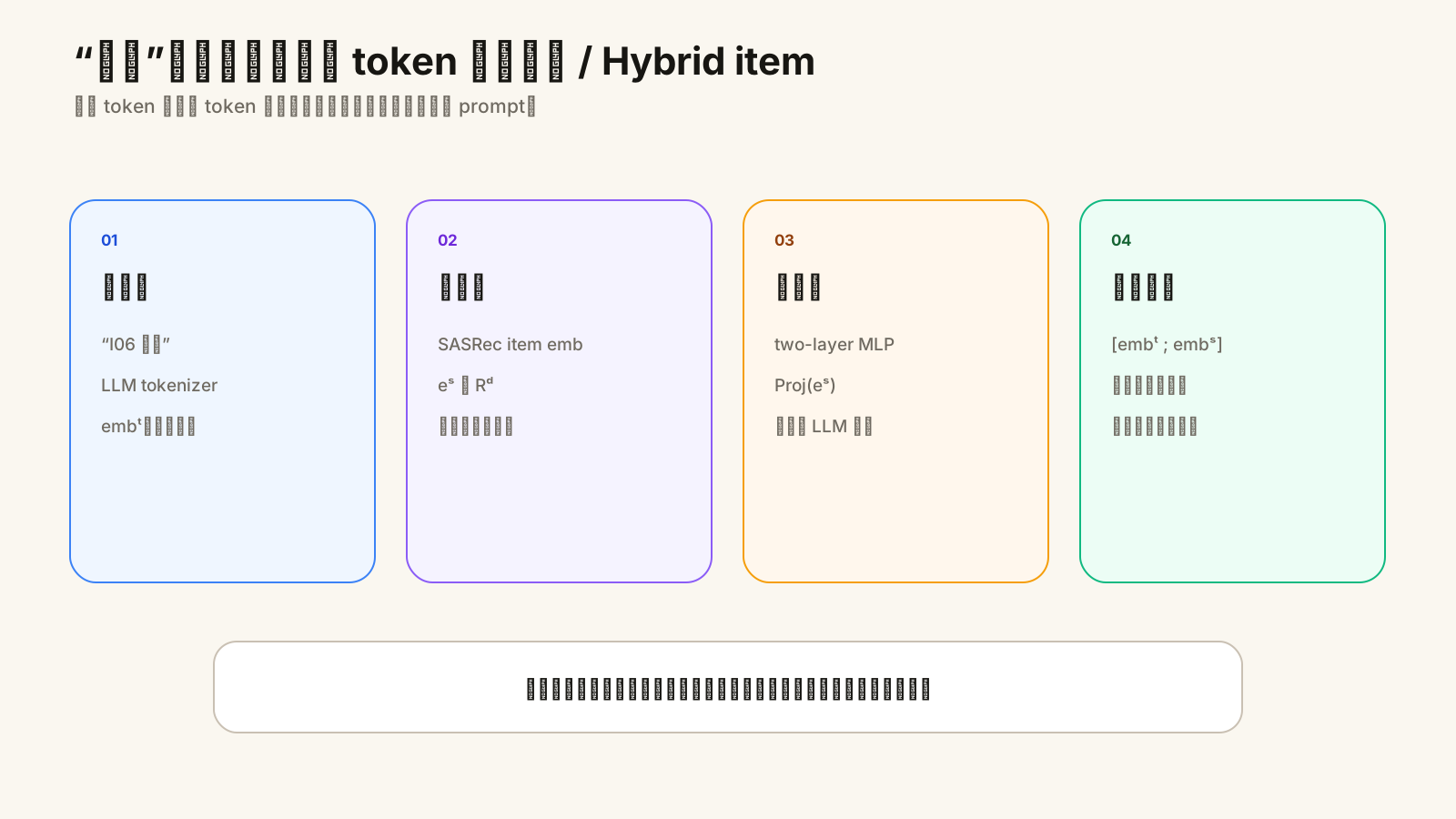
Figure 2. Text invokes world knowledge; behavior carries the recommender distribution. The projector creates an input interface, not a guarantee of perfect semantic alignment.
What happens from model input to output?
Injecting unfamiliar behavior tokens from the first step forces the LLM to learn several things simultaneously: the recommendation task, candidate-only output, the meaning of projected vectors, and conflict resolution between text and behavior.
LLaRA therefore uses curriculum prompt tuning.
Easy task: text-only prompt
Each title is followed by a special placeholder [PH]:
Titanic [PH], Roman Holiday [PH], ...
The input remains native text. The model first learns the task and answer format.
Hard task: hybrid prompt
Each [PH] is replaced by the projected behavior token:
Titanic <behavior_14>, Roman Holiday <behavior_20>, ...
Both history and candidates use hybrid representations.
Curriculum scheduler
At training time out of total , the hard-task probability grows linearly:
Early batches are mostly easy; late batches are mostly hard. LoRA adapts the LLM while the projector is trained jointly.
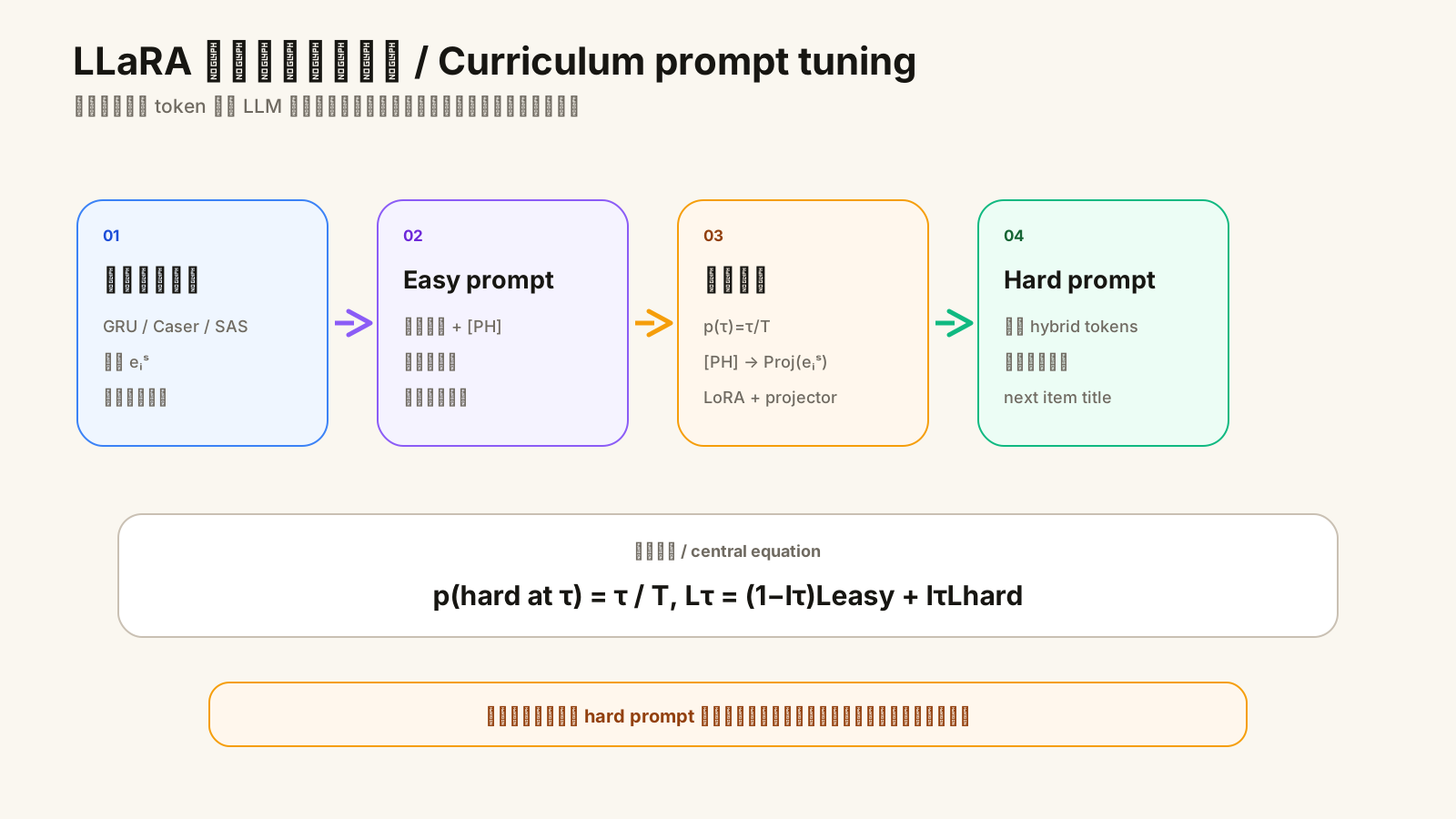
Figure 3. The curriculum is a changing sampling probability, not a hard switch after a fixed number of epochs.
For batch size , history length , and candidate count :
| Representation | Typical shape | Meaning |
|---|---|---|
| recommender item embeddings | ID-based behavior knowledge | |
| projected behavior | one LLM-compatible token per item | |
| title tokens | variable | language representation |
| final prompt | interleaved text and behavior |
Unpack the central equation
Training samples either the easy or hard loss:
- is token NLL for titles plus
[PH]; - uses titles plus behavioral tokens;
- selects the hybrid prompt;
- increases the hybrid probability over training.
The expected loss is
This displays a continuous path from language prior to behavioral modality. Difficulty need not increase in every consecutive batch, but its global proportion does.
Training versus inference
# first train a conventional sequential recommender
SR = train(GRU4Rec or Caser or SASRec, item_sequences)
item_behavior = SR.item_embeddings

# tune LLaRA
for step tau in 1...T:
    p_hard = tau / T
    if random() < p_hard:
        prompt = titles + Project(item_behavior)
        loss = hard_token_nll(prompt, true_next_title)
    else:
        prompt = titles + [PH]
        loss = easy_token_nll(prompt, true_next_title)

    update LoRA and projector
Inference:
history = hybrid_tokens(user_history)
candidates = hybrid_tokens(candidate_set)
prompt = format(history, candidates)
answer = constrained_or_parsed_generation(prompt)
return the matching candidate
The paper samples twenty non-interacted negatives and adds one true next item, producing 21 candidates. The LLM generates one title and HitRatio@1 measures exact selection.
What do the experiments actually prove?
The paper compares conventional sequential models, vanilla Llama2, GPT-4, MoRec, TALLRec, and LLaRA:
| Model | MovieLens HR@1 | Steam HR@1 | LastFM HR@1 |
|---|---|---|---|
| TALLRec | 0.3895 | 0.4637 | 0.4180 |
| best LLaRA variant | 0.4737 | 0.4949 | 0.4508 |
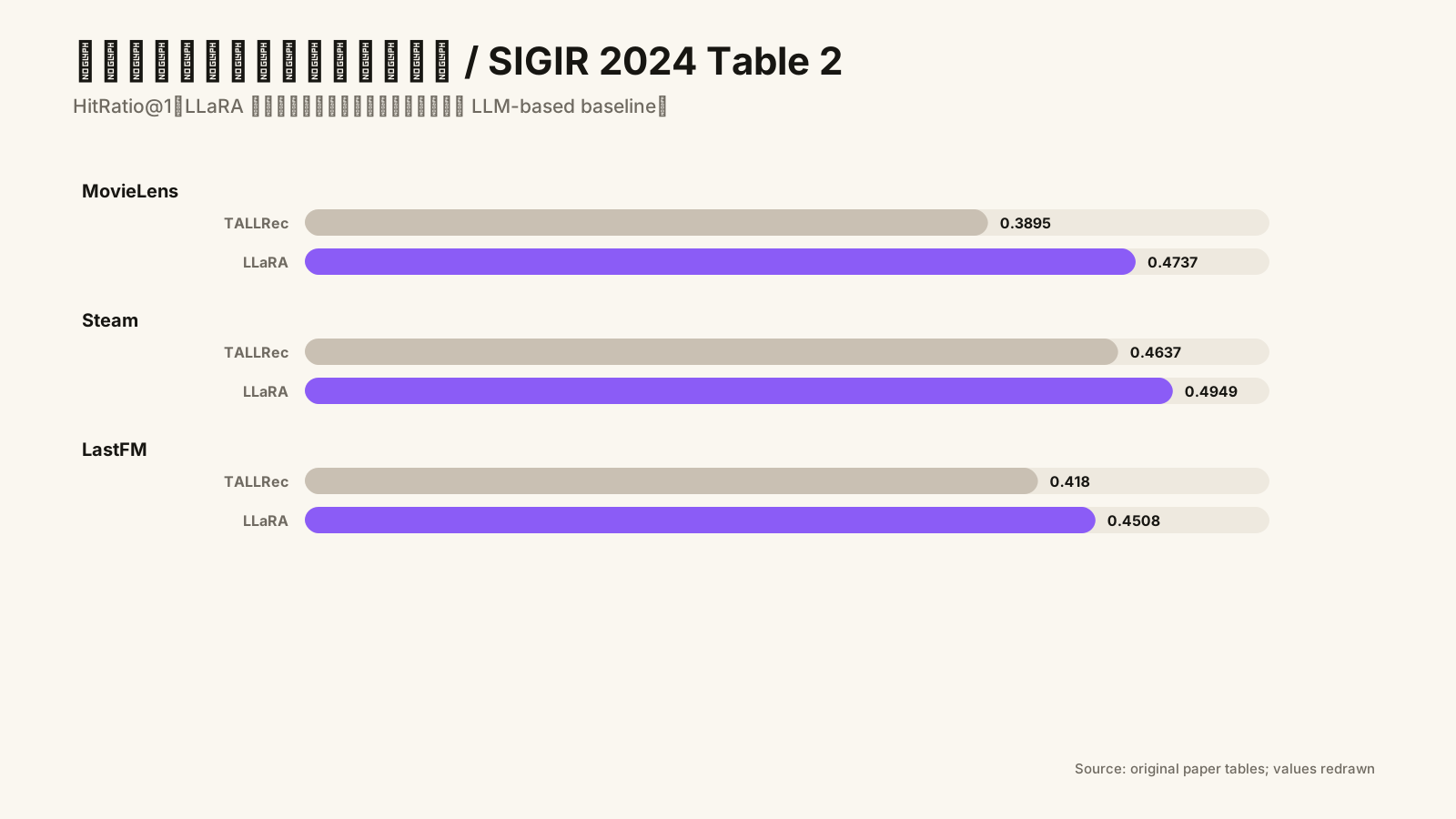
Figure 4. Values from Table 2. The chart takes the best GRU4Rec-, Caser-, or SASRec-backed LLaRA variant for each dataset.
ValidRatio is equally revealing:
- vanilla Llama2: 0.4421 on MovieLens, 0.1653 on Steam, and 0.3443 on LastFM;
- LLaRA variants: all above 0.95, with some reaching 1.0.
Instruction tuning improves not only selection but the probability of returning a parseable candidate.
Ablations support both components:
- numeric indices alone, behavioral tokens alone, and titles alone all trail the hybrid form;
- curriculum beats direct and two-stage training on MovieLens and Steam;
- on LastFM, curriculum 0.4508 ties direct training at 0.4508, so it is not a strict universal improvement;
- GRU4Rec, Caser, and SASRec all supply usable behavior embeddings.
Case studies illustrate complementary failure modes. When the answer depends on film semantics, TALLRec and LLaRA can beat SASRec. When it follows an anonymous sequential pattern, SASRec and LLaRA can beat text-only TALLRec. These cases agree with the hybrid hypothesis but are interpretive evidence rather than causal proof.
Where does it fail?
1. It remains small-candidate reranking
Hit@1 among 21 candidates is far easier than million-item retrieval or generation. Candidates are supplied externally; LLaRA does not unify recall.
2. It first needs a conventional recommender
The “LLM recommender” depends on GRU4Rec, Caser, or SASRec to produce embeddings. Training, updates, and versioning still span two systems.
3. Cold items lack mature behavior tokens
Text describes a new product, but its collaborative embedding has little evidence. The hybrid representation becomes asymmetrical under cold start.
4. Projection is an interface, not semantic proof
A two-layer MLP matches dimensions. It does not explicitly require behavior neighborhoods to correspond to interpretable language concepts.
5. Free generation can remain invalid
ValidRatio improves dramatically but is not inherently 100%. Production still benefits from candidate-constrained decoding or a trie.
6. Curriculum gains are small and inconsistent
Table 3 gains are often a few points, and LastFM ties direct training. The extra scheduler must justify itself for each dataset.
7. Text length and candidates multiply cost
Every historical and candidate item carries title tokens plus a behavior token. Expanding the candidate set quickly expands the prompt and the LLM forward pass.
Why does the next paper need to exist?
The second act has made five moves:
- P5: unify tasks as text-to-text;
- M6-Rec: deploy a shared foundation across an industrial stack;
- TALLRec: cross the language–recommendation gap with a little supervision;
- ReLLa: retrieve target-relevant lifelong behavior;
- LLaRA: combine language knowledge with collaborative behavior.
Most of these systems still score or generate inside a supplied candidate set. Retrieval remains external, and Item IDs remain arbitrary labels.
DSI, the next paper, temporarily leaves recommendation for the origin of generative retrieval. If a model can memorize document content in its parameters and generate a document ID directly, does retrieval still require the path “query vector → external index → nearest neighbor”?
That idea will lead to TIGER’s Semantic IDs and become a common ancestor of the series’ second half.
Paper: Liao et al., “LLaRA: Large Language-Recommendation Assistant,” SIGIR 2024.
Primary source: arXiv:2312.02445
Series: Twenty Papers to Understand the Past and Present of Generative Recommendation